MedeA Builders
The MedeA Environment includes a rich set of builders for many types of systems and applications. Use MedeA’s Builders for constructing atomic-scale models of hard, soft or fluid materials. Work with crystalline or amorphous materials, bulk or surface systems, defect structures, molecules, nanostructures and adsorbates. Complementing MedeA’s standard building capabilities are several specialized modules for building complex and hybrid materials such as amorphous materials, cross-linked polymers or composite structures. In addition, MedeA offers tools to construct heterogeneous interfaces, grain boundaries, and for docking molecules in microporous structures.
MedeA Standard Builders
MedeA Specialty Builders
MedeA Standard Builders
MedeA Crystal Builder ✓ Part of the standard MedeA Environment
Use MedeA’s Crystal Builder to edit and modify periodic structures retrieved from MedeA’s experimental structure databases. While this is the most convenient way of constructing a periodic structure in MedeA, you can also build crystalline systems from scratch by selecting the desired space group and adding elements at Wyckoff positions. You may set or change cell parameters, replace or move atoms, set magnetic moments and masses, and freeze selected atomic degrees of freedom. Let MedeA determine a given system’s symmetry, while you choose an appropriate representation, i.e. P1, primitive cell, or highest available symmetry.
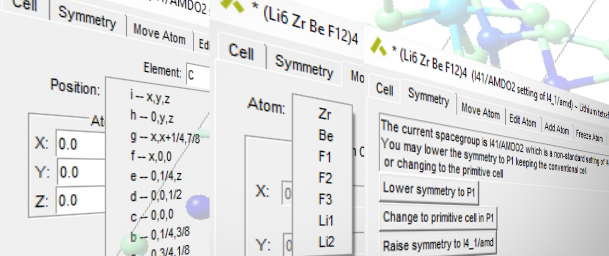
MedeA Crystal Builder features include:
Display and edit crystal structures from MedeA’s InfomaticA
Find symmetry and add atoms at Wyckoff positions
Edit cell dimensions and angles
Edit elements, move atoms and freeze atomic degrees of freedom
Assign masses and magnetic moments
MedeA Molecular Builder ✓ Part of the standard MedeA Environment
MedeA Molecular Builder lets you import and edit molecular systems, or build them stepwise using the MedeA molecular fragment library. Simply paste SMILES code from external sources into the builder, and clean up the resulting molecular systems by running minimizations or short molecular dynamics interactively. Create periodic systems from molecules, or split periodic structures into molecular components. Use building blocks from MedeA’s fragment library to construct complex systems, define polymer backbones and store your own structures for later reference.
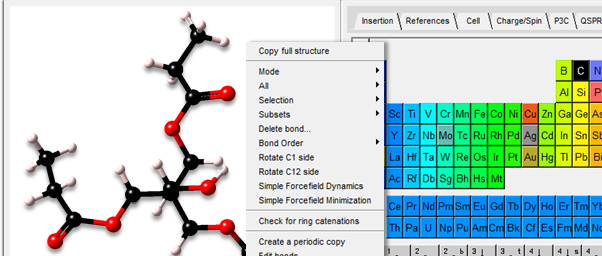
MedeA Molecular Builder features include:
SMILES input
Convenient Insertion mode: Load cursor with atom or molecular fragment, click to add freely or dock to active bonds
Internal coordinates representation and modification
MedeA Conformer Search ✓ Part of the standard MedeA Environment
Search for lowest lying conformers of any type of organic molecular input structure. Display selected systems or create a structure list from all results or selected subsets.
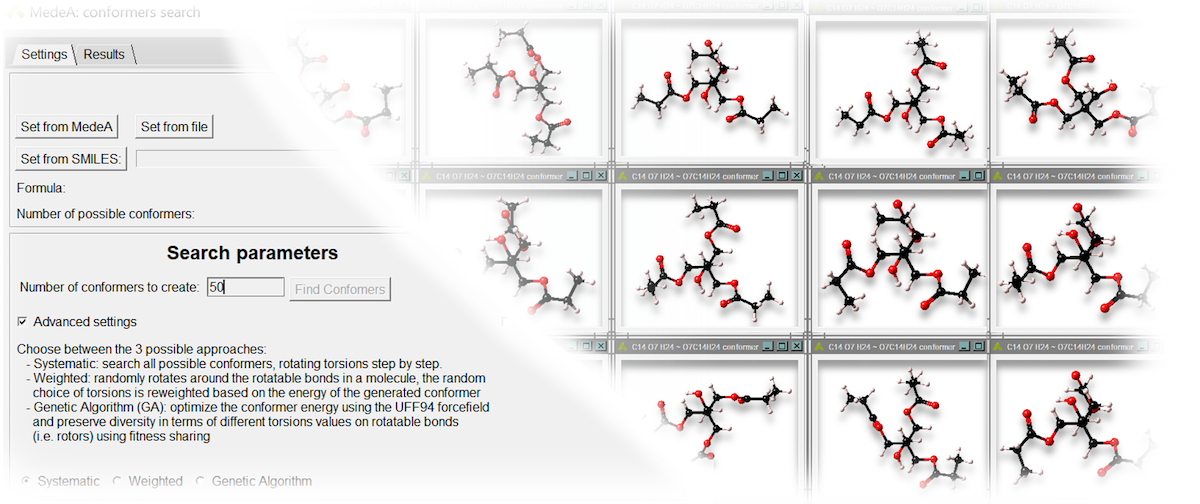
MedeA Conformer Search features include:
SMILES input
Several search algorithms
Genetic algorithms and UFF94 forcefield
Weighted search
Systematic search
MedeA Supercell Builder ✓ Part of the standard MedeA Environment
Use MedeA’s Supercell Builder to quickly generate larger cells, multiples of the chemical or mesoscale unit cell in selected directions. Build elongated cells by defining a range parameter or transform unit-cell coordinate axes to create a custom coordinate base.
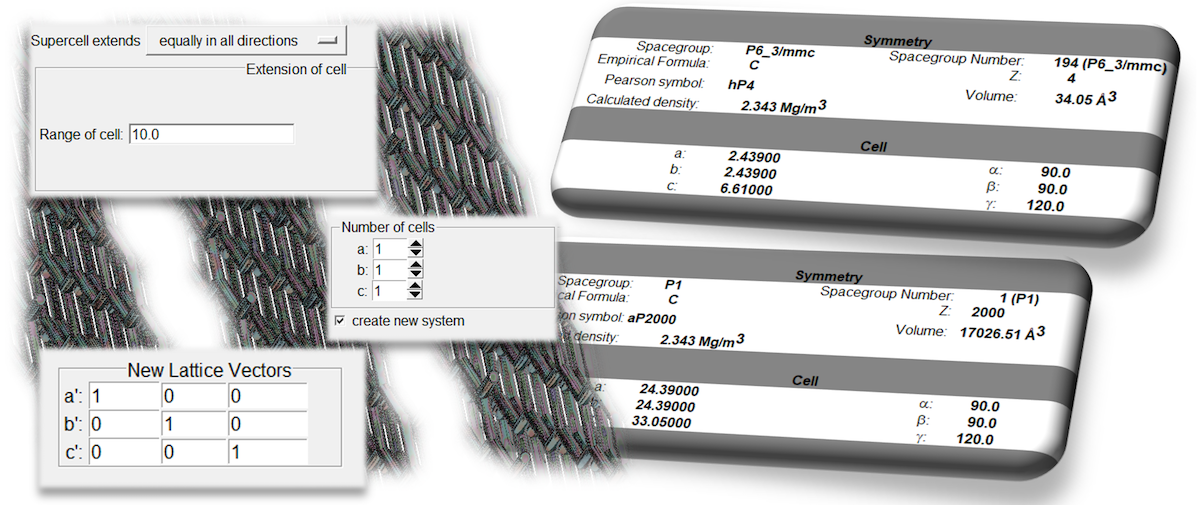
MedeA Supercell Builder features include:
Simple: Define multiples in each lattice direction
Automatic: Provide a range parameter for all or selected directions
Custom: Use a transformation matrix to define a new lattice
MedeA Special Quasirandom Structures (SQS) ✓ Part of the standard MedeA Environment
Use MedeA’s Special Quasi Random Structures (SQSs) as a simple means to model alloys. With a rather small number of atoms, SQSs mimic the physically most relevant radial correlation functions of a perfectly random structure. Simply select ‘SQS’ from the builder menu and edit starting lattice parameters.
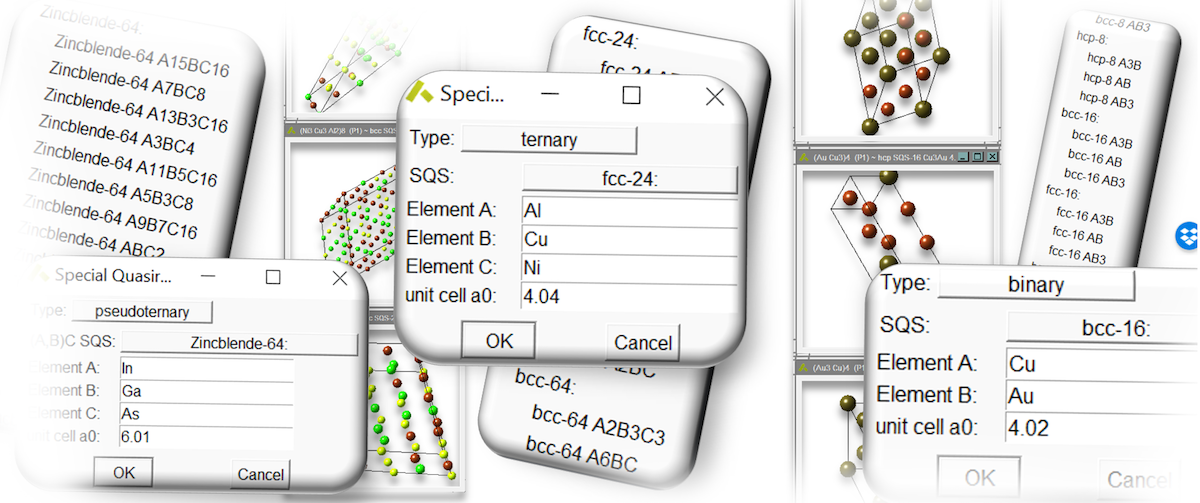
MedeA SQS Builder features include:
Binary: fcc, bcc, hcp
Ternary: fcc, bcc, B2
Pseudo-ternary: Zincblende-64 structures
MedeA Polymer Builder ✓ Part of the standard MedeA Environment
The MedeA Polymer Builder creates models of isolated polymer chains, providing a foundation for building more complex models. Examples include bulk polymers, blends, solutions, or multiphase systems incorporating one or more interfacial regions.
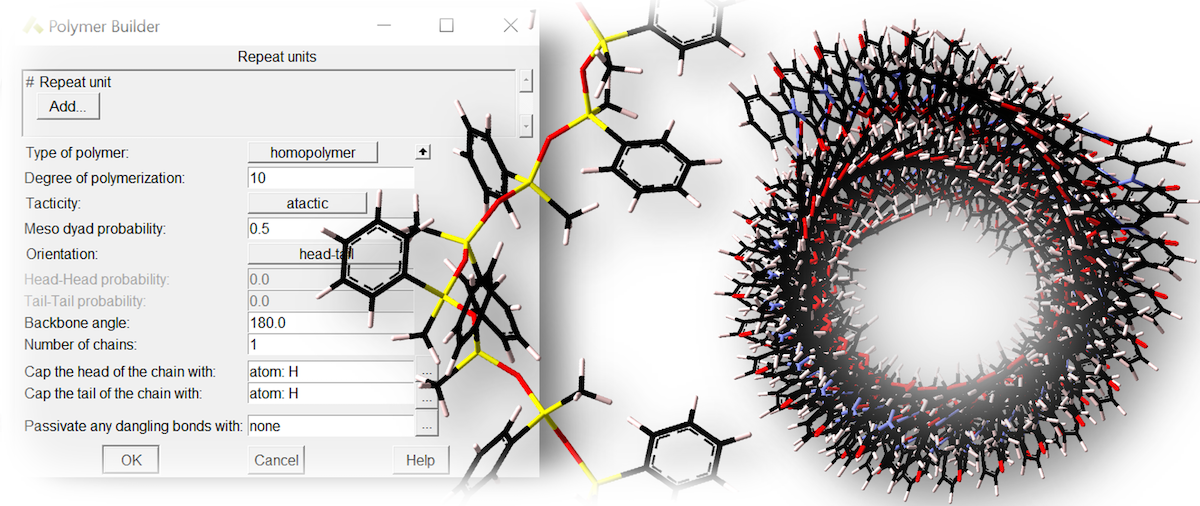
MedeA Polymer Builder features include:
Extensive Polymer repeat unit library
Customized repeat units from monomers
Handles tacticity, repeat unit orientation
Builds alternating, random and block copolymers
Works with atomistic or mesoscale repeat units
(see datasheet for more details)
MedeA Nanobuilder ✓ Part of the standard MedeA Environment
With MedeA’s Nanobuilder, you can construct nano-sized structures of various shapes. With just a few mouse clicks, build spheres, cylinders, tubes, wraps or wires by simply selecting from a handful of input parameters such as element type, chirality, orientation, packing and degree of nesting!
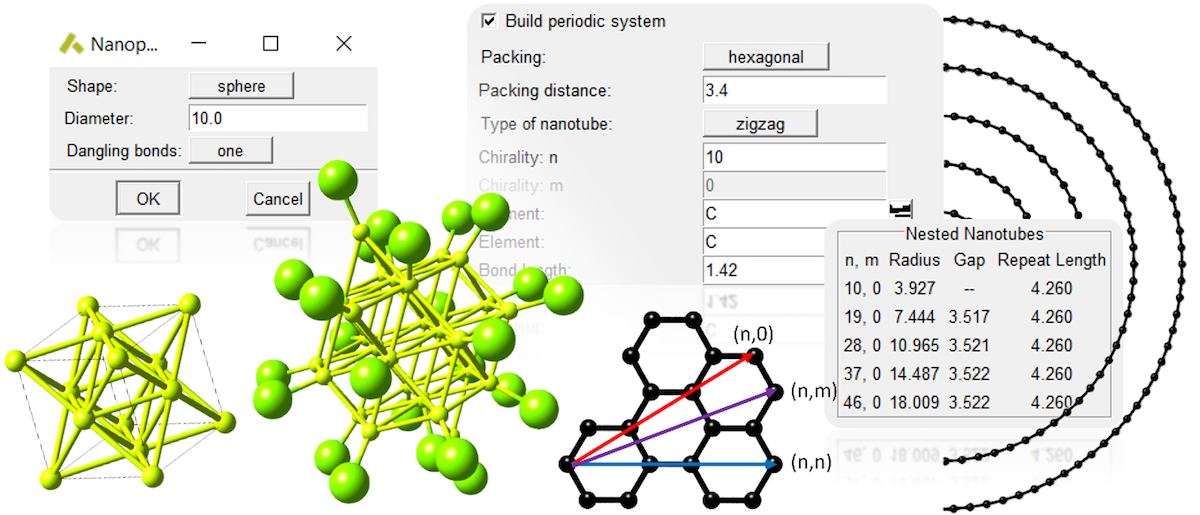
MedeA Nanobuilder features include:
Interactive GUI-based Builder
Intuitive design criteria guiding construction
Many shapes and geometries supported
Full integration with other MedeA builders and modules
MedeA Surface Builder ✓ Part of the standard MedeA Environment
MedeA Surface Builder provides an intuitive way for constructing surface models by cleaving a bulk system. Start with a periodic chemical unit cell loaded from InfomaticA. Select cleavage direction, layer thickness and vacuum thickness. MedeA displays the corresponding surface slab model. If desired, use upper and lower cleavage planes to control surface termination, find new symmetry and apply to create your final surface slab model. Use cell transformation and supercell builder to increase surface plane area, e.g. for construction of adsorbate-adsorbent models.
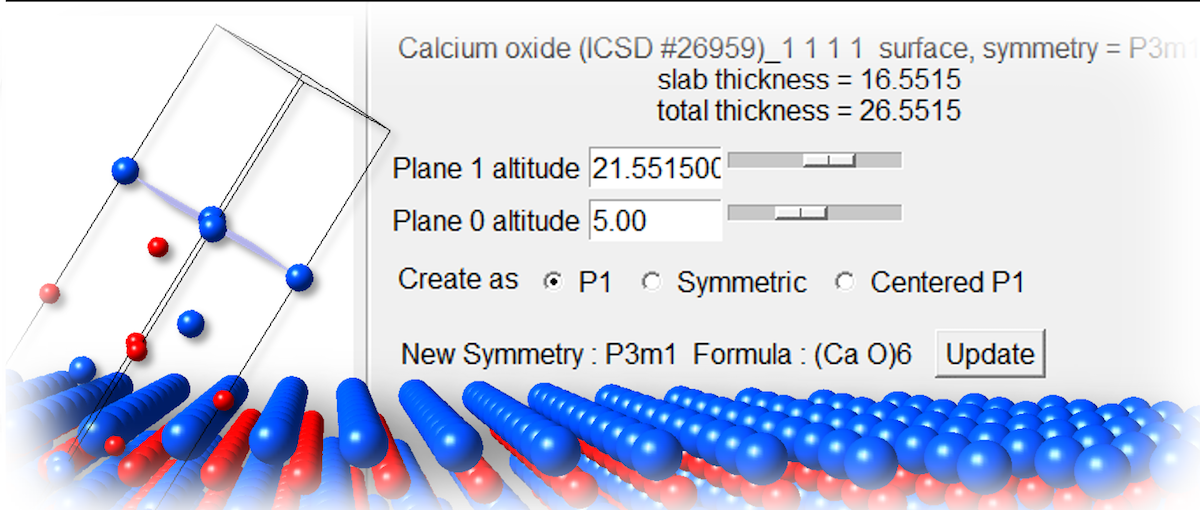
MedeA Surface Builder features include:
Choose Miller indices, material thickness and vacuum layer thickness
Preview and edit surface slab model
Control surface termination and modify vacuum layer thickness
MedeA Stack Layer Builder ✓ Part of the standard MedeA Environment
MedeA Stack Layer Builder is designed for preparation of interface systems comprising two or more layers of materials. You may combine individual layers of amorphous and crystalline nature, solids, liquids, partially ordered liquid crystal systems and vacuum regions. The builder can process organic, inorganic or metallic systems.
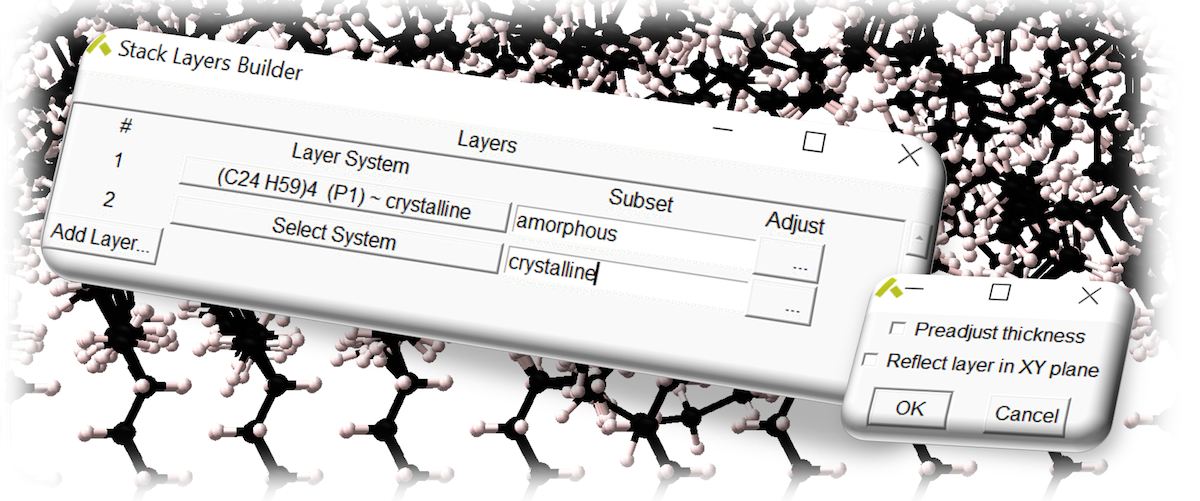
MedeA Stack Layer Builder features include:
Add multiple layers
Works with MedeA subsets to allow analysis of specific atoms in layer
Adjust layers relative to each other
Control individual layer thickness upon final assembly
Quick creation of bilayers by in-plane reflection
MedeA Substitutional Builder ✓ Part of the standard MedeA Environment
MedeA Substitutional Search Builder let’s you explore symmetry and structure of systems with substitutional defects. For any type of input systems MedeA lists symmetrically different structures as you replace 1, 2, or more element types. Sort the resulting list by relative weight, symmetry, number of atoms per cell or nearest neighbor distance.
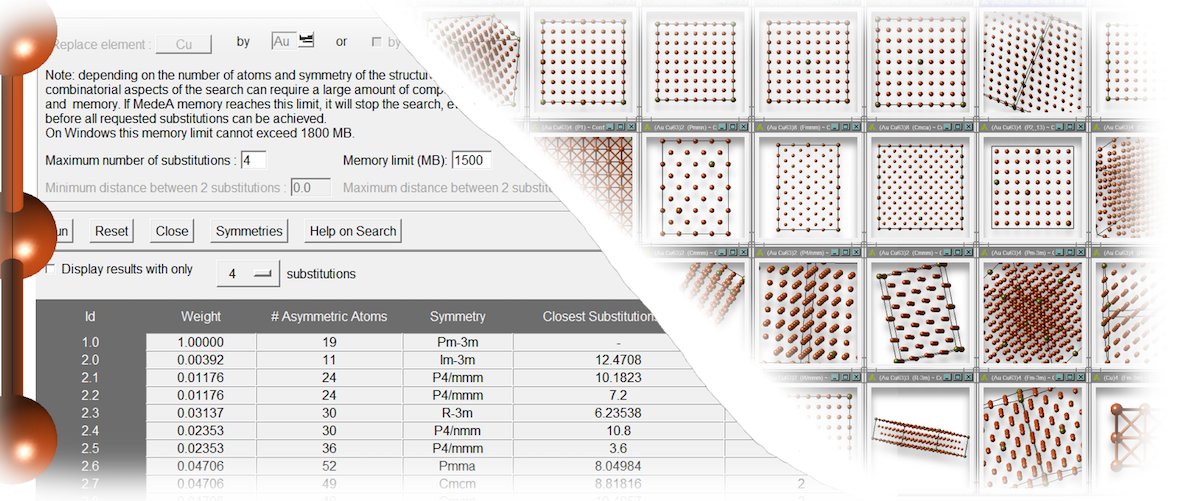
MedeA Substitutional Search Builder features include:
Systematic symmetry analysis of substitutional defect/vacancy structures
Ranking by structural parameters such as e.g. nearest defect distances
Produces defect structures ready for DFT total energy calculations
MedeA Random Substitutions ✓ Part of the standard MedeA Environment
MedeA Random Substitutions provides an intuitive way for creating defect or vacancy structures when one or larger numbers of elements need to be replaced. Define a set of rules to perform substitutions repeatedly, create multiple configurations and save results to structure lists for subsequent processing.
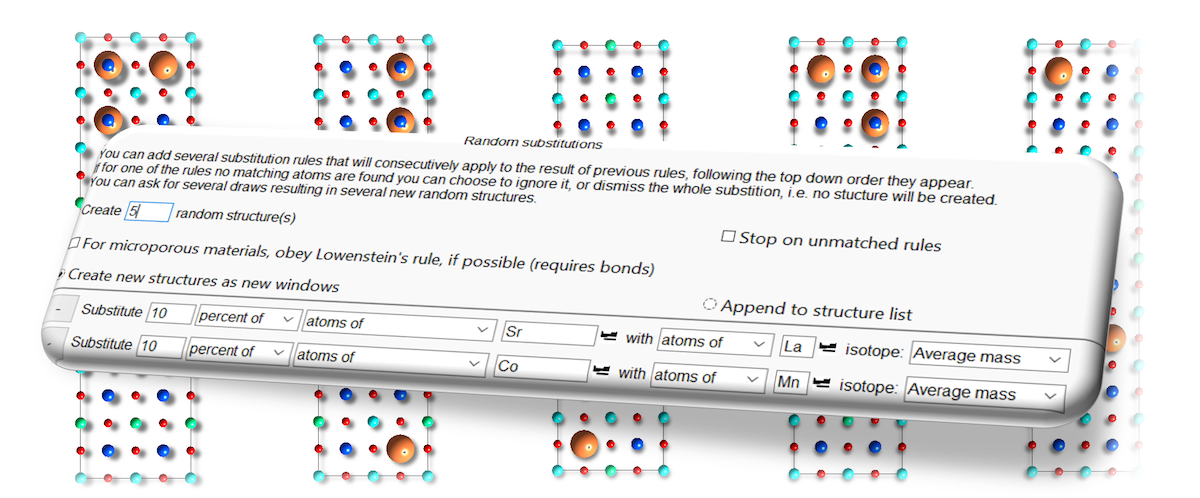
MedeA Random Substitutions features include:
Define attributes for atoms to substitute: by name, subset, element type, etc.
Choose % or define number of substitutions to be performed
Create multiple configurations and save to structure lists
MedeA Specialty Builders
MedeA Amorphous Materials Builder
The MedeA Amorphous Materials Builder lets you efficiently create condensed phase models based on system chemical or mesoscale composition and target density. It eliminates the need for lengthy mixing and amorphization simulations through realistic sampling of the translational, rotational, and conformational degrees of freedom of component species.
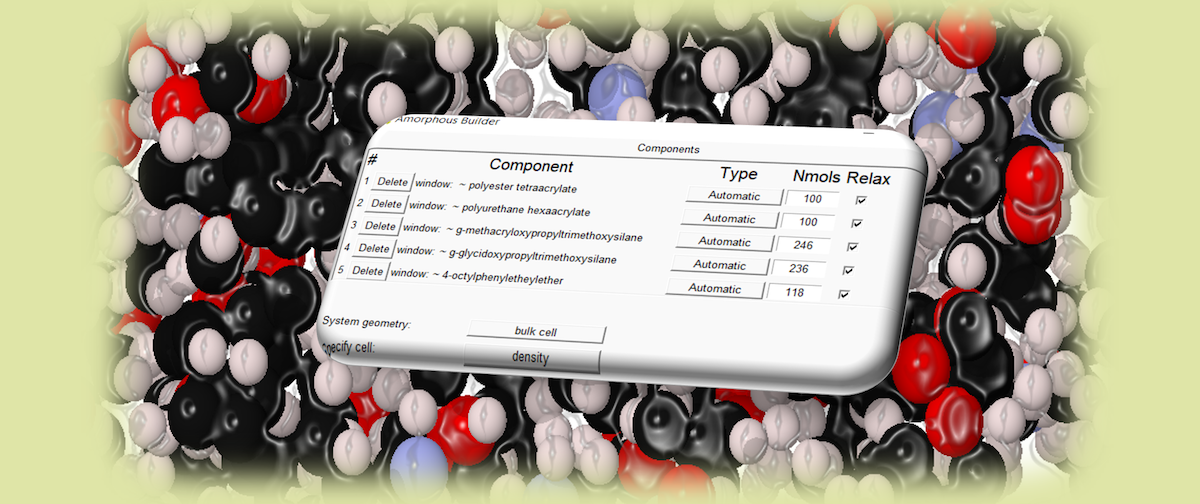
The MedeA Amorphous Materials Builder key benefits and features include:
Creates realistic configurations of a broad range of materials including
Polymers and polymer blends
Small molecule fluids
Liquid mixtures and electrolytes
Mixed oxide glass melts (see datasheet for full list)
Mesoscale systems
Integration with other modules using MedeA’s Flowcharts
MedeA Thermoset Builder
MedeA Thermoset Builder applies state-of-the-art methods for creating complex topologies of polymer networks in order to create strain-free molecular or mesoscale models with experimentally observed crosslink densities.
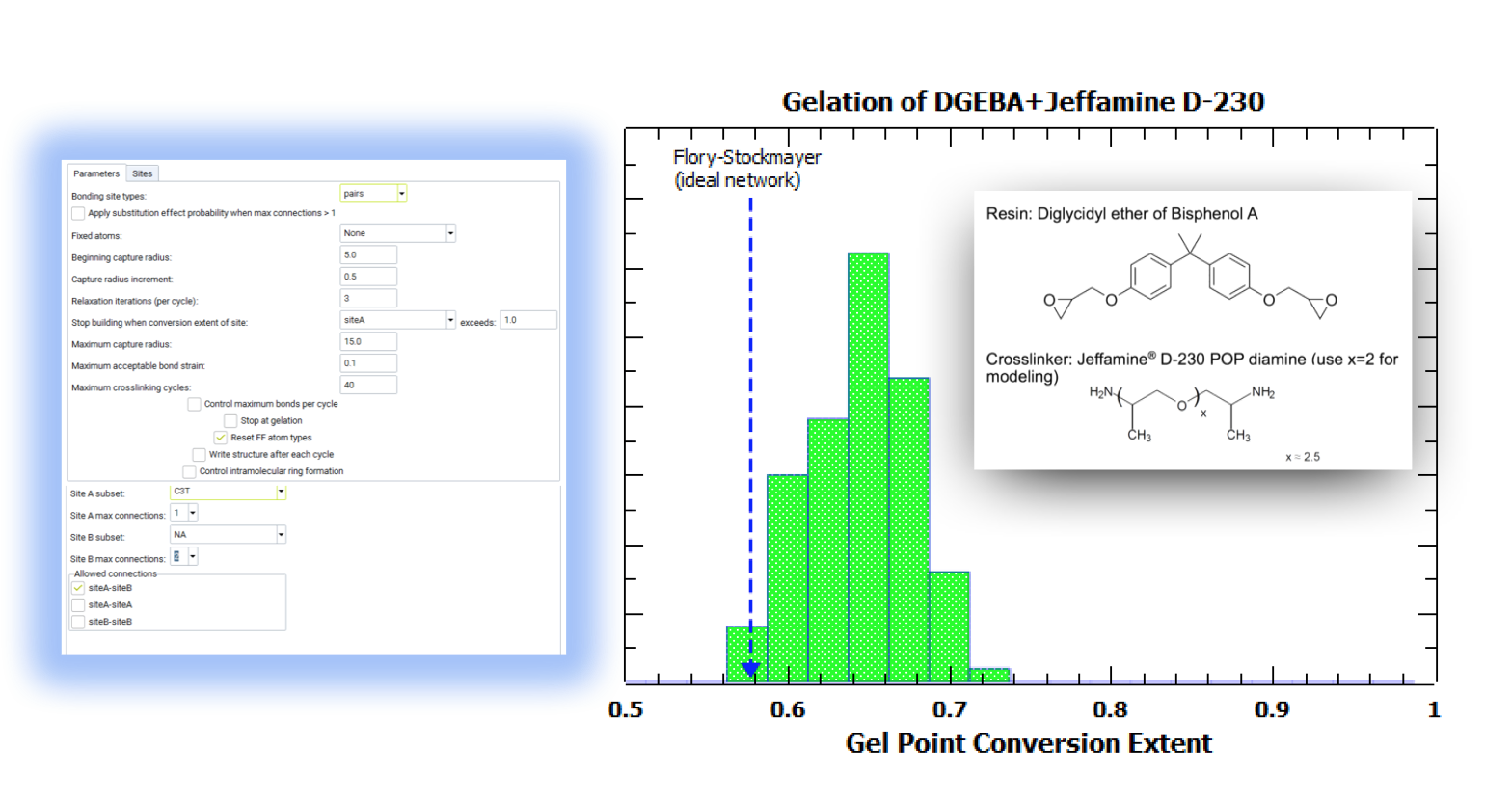
Key features include:
Full integration into MedeA’s Flowcharts, for batch processing and property averaging
Rigorous monitoring of material characteristics during crosslinking
Lets you combine resins, curing agents and solvents
Enables studies of particle and fiber-reinforced composites
Creates realistic models for a wide range of thermosets including:
Epoxies
Polyesters (alkyds)
Cyanate esters
Epoxy-Phenol-Novolac molding compounds
Mesoscale systems
(see datasheet for full list)
MedeA Interface Builder
The MedeA Interface Builder lets you create an explicit, atomic-scale interface from two surfaces, allowing for a predefined maximum in-plane mismatch between adjoining layers. The MedeA Interface Builder helps to identify and build twist grain boundaries as well as coherent, and/or semi-coherent interfaces. It produces periodic, commensurate cells, which may be used as direct input for MedeA’s compute work flows, engaging VASP, LAMMPS, or any other engine or building stage. Naturally, you can further edit interface structures in MedeA, e.g. by adding impurities, vacancies and interstitial defects as appropriate.
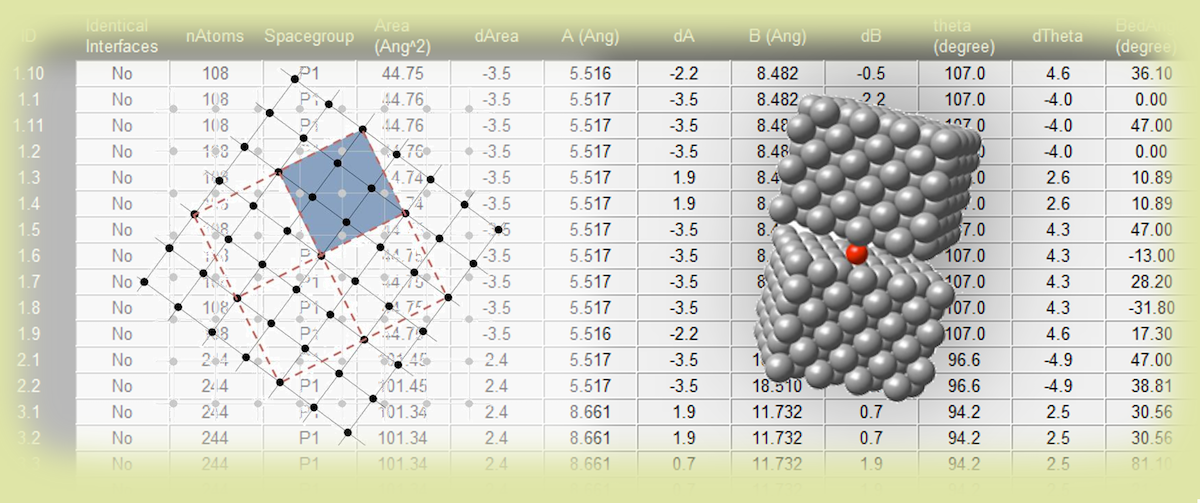
The MedeA Interface Builder key features include:
Accounts for relative materials stiffness
Offers solutions for commensurate cells of different size and symmetry
Allows exploration of lateral offsets (gamma surface)
Full integration with MedeA’s Compute Engines and other Modules
(see datasheet for more detail)
MedeA Mesoscale Builder
The MedeA Mesoscale Builder creates models for simulations on the time and length scale of microseconds and tens of nanometers. The models created can be used with other MedeA tools to build more complex systems, such as polymers or thermosets. Mesoscale bead definitions and parameters are provided for the MARTINI and SPICA forcefields.
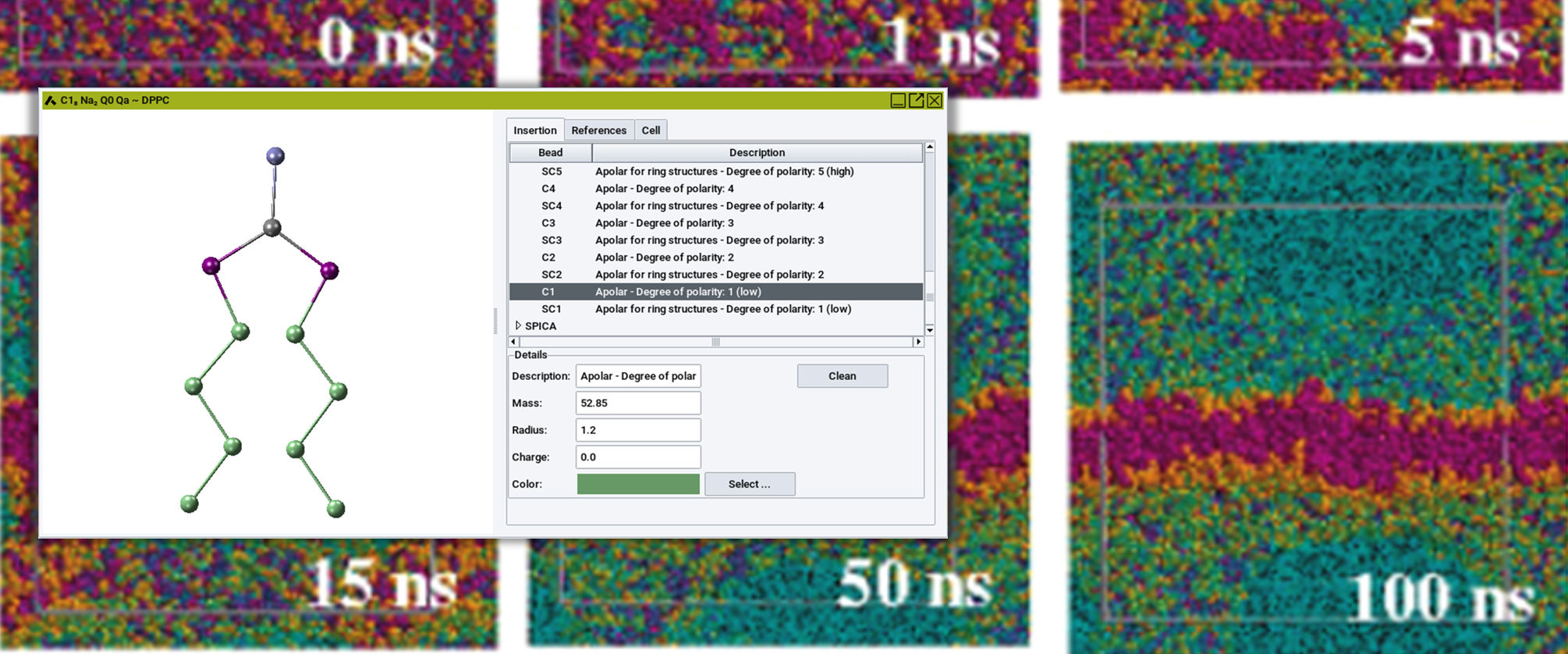
The MedeA Mesoscale Builder key features include:
Quickly build mesoscale models with beads from the scientific literature
Utilize the MARTINI and SPICA forcefields
Define your own beads
Use mesoscale models with Polymer, Amorphous, and Thermoset builders
Use mesoscale models to run MedeA LAMMPS simulations on time and lengths scales which exceed atomistic modeling
MedeA Microstructure Builder
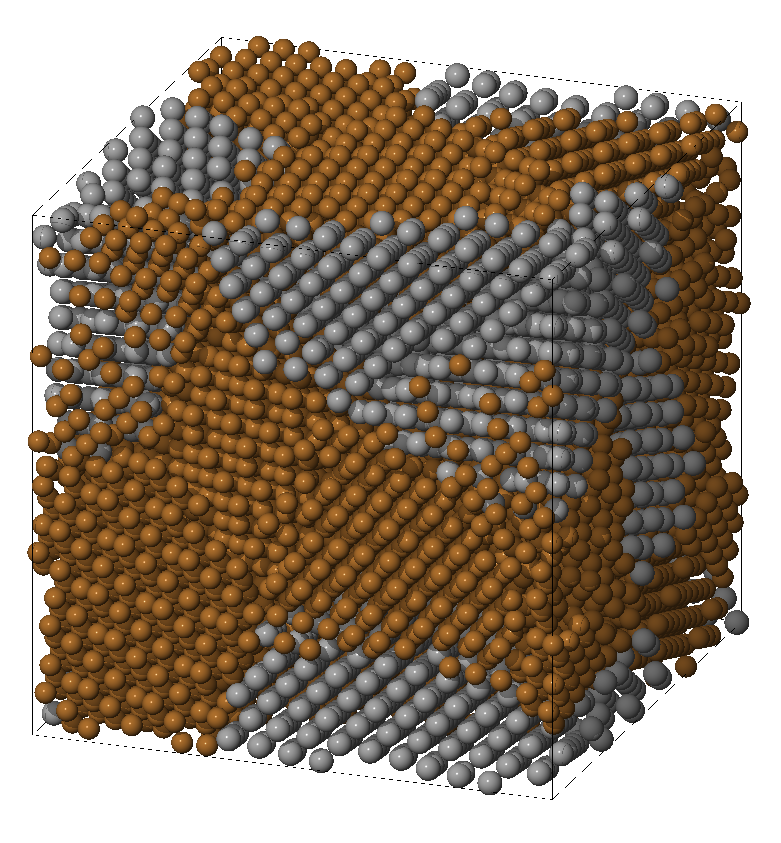
The MedeA Microstructure Builder creates microstructure models for atomistic simulations using a Seed & Growth algorithm with starting points either placed randomly or at user-specified coordinates within a supercell. Each such point is used as an origin to grow a crystalline grain by adding atoms from that seed point outwards, until a grain boundary is encountered.
The models created by the MedeA Microstructure Builder can be used with other MedeA tools to explore the structural, energetic, and dynamical characteristics of microcrystalline materials.
The MedeA Microstructure Builder key features include:
Interactive microstructure model construction based on crystalline starting points.
Flexible control over composition and seed density
Creation of micrstructure models suitable for use in MedeA LAMMPS and MedeA GIBBS simulations employing accurate forcfields, including machine learning potentials