MedeA UNCLE Explore Phase Stability, Bridge the Length Scales
At-a-Glance
MedeA®[1] UNCLE (UNiversal CLuster Expansion) [2],[3] expands access to materials and properties at the mesoscopic and microscopic scales, while retaining the predictive power and accuracy of ab-initio Density Functional Theory (DFT). Explore order-disorder phenomena and phase segregation processes as a function of temperature and composition, and predict additional scalar properties such as band gaps or bulk moduli.
Key Benefits
Models systems containing millions of atoms with DFT accuracy
Train and evaluate cluster expansions to predict energies and secondary scalar properties such as band gaps or bulk moduli.
Streamlined, user-friendly setup within the MedeA Environment
Automated, workflow-based refinement of cluster expansions
Efficiently manage hundreds of input structures
Gain insight with intuitive graphical analysis and visualization tools
Flexibly split and restart complex calculations
Extend and expand existing cluster expansions with ease
Cluster Expansion with MedeA UNCLE
MedeA UNCLE lets you determine stable multi-component crystal structures and rank metastable structures by enthalpy of formation, while maintaining DFT accuracy. VASP ab-initio calculations are performed on automatically chosen sets of small models to obtain effective interaction parameters. Use these in a Monte Carlo simulation to capture the configurational complexity of real materials at different temperatures.
On the one hand, cluster expansions are used to treat systems ranging from a few up to a million atoms without giving up the accuracy of modern DFT calculations. On the other hand, Monte Carlo simulations permit us to study finite-temperature properties such as short range order phenomena or mixing enthalpies.
Stefan Müller (introduction of [3])
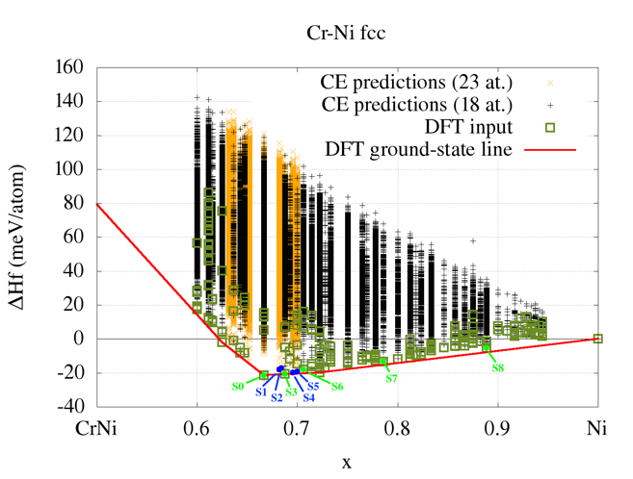
Ground state diagram (convex hull) for the Cr-Ni system
Tight integration with MedeA‘s job control guarantees ease of use, stability, and fault tolerance. Monitor progress of these fully automated calculations, and use graphical tools to readily visualize results.
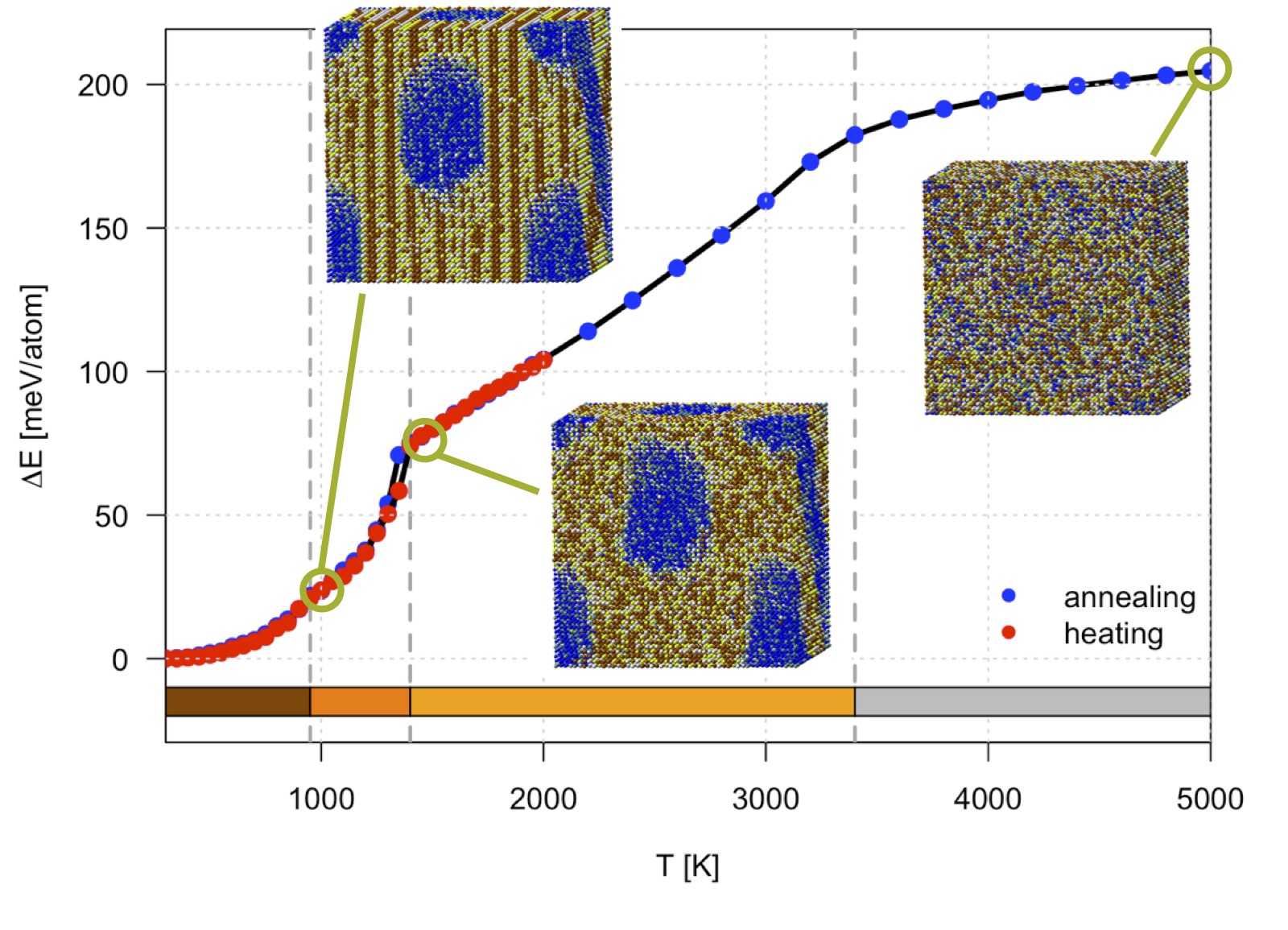
Monte Carlo temperature profile (heating and cooling curves) and simulation cells for a 5 component high-entropy alloy
Properties from MedeA UNCLE
Ground state diagram (convex hull)
Structures of stable phases
Vacancy concentrations
Miscibility
Random mixing energy
Phase stability as a function of temperature and concentration
Solubility
Order-disorder transition temperature
Microstructure
Short range order parameter
Surface segregation
Surface coverage of adsorbents
Secondary scalar properties such as mechanical, optical or electronic properties
Computational Characteristics
Use Genetic Algorithm or Compressive Sensing
Full integration with MedeA VASP and other modules
High-throughput using the MedeA JobServer
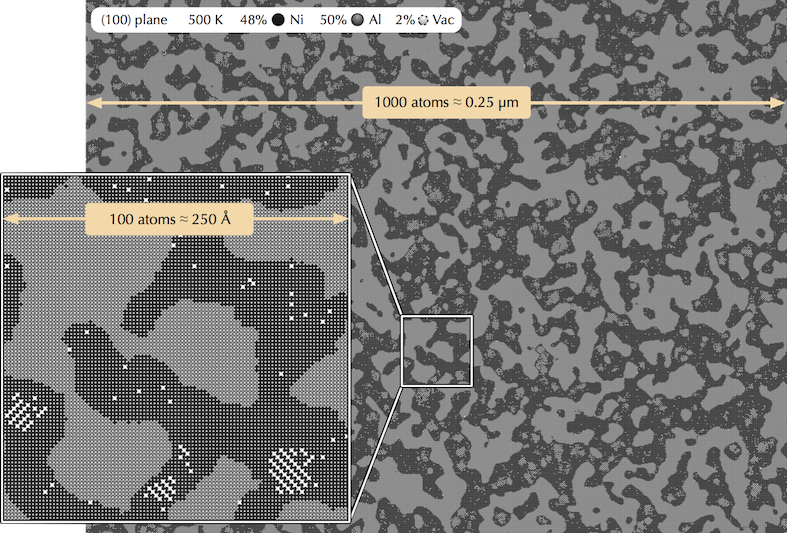
NiAl alloy: (100) cut through a 1000 x 1000 x 1000 simulation cell superlattice with 2% constitutional vacancies at T = 500K.
Required Modules
MedeA Environment
MedeA UNCLE
MedeA VASP
Find Out More
Learn more about MedeA UNCLE applications and examples by watching the webinar MedeA UNCLE: Atomistic Studies of Crystalline Systems at Higher Scales.
Find out more by visiting the Materials Design Application Notes:
Adaptive Crystal Structures of Au-Cu Alloy
Structure and Bonding of Boron Carbide
- download: