MedeA Pearson - The Essential Crystal Structure Data Resource for Inorganic Materials Science and Engineering
MedeA®[1] Pearson, the world’s largest experimental database for inorganic structures, delivers crystallographic data extracted from nearly 100,000 publications. MedeA Pearson provides detailed crystal structure information for alloys and intermetallics, ceramics, and minerals.
At-a-Glance
The integration of MedeA Pearson with all MedeA modules accelerates project execution by providing direct structure input for property predictions and high-throughput simulations.
Key Benefits
Seamless integration with MedeA InfoMaticA, MedeA workflows, and MedeA compute engines
Provides project planning with exhaustive account of chemical inventory
The crystal structure data are processed and evaluated by expert scientists
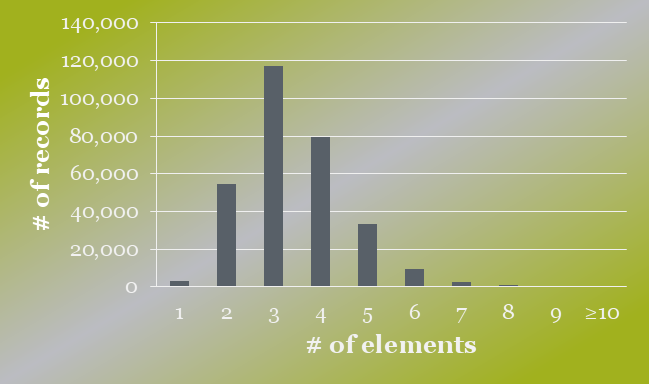
MedeA Pearson - number of records by constituent count
With a particular focus on alloys and intermetallics, MedeA Pearson provides exhaustive coverage of crystal structure data for inorganic compounds obtained from neutron diffraction and X-ray diffraction (XRD) powder diffraction measurements. Together with MedeA InfoMaticA, MedeA Pearson is an ideal starting point for building atomistic models of bulk phases, defect structures, surfaces, and interfaces.
An exhaustive resource of experimental crystal structure data, in particular for alloys and intermetallics.
Specifications
World’s largest critically-evaluated, ‘non-organic database’
Excellent coverage of alloys and intermetallics
Encompasses more than 300,000 structure records of more than 95,000 different phases
About 173,000 distinct chemical formulas
1 GB database file stored on disk
Key Features
Provides on-disk, cross-database search in combination with MedeA InfoMaticA
Quick, efficient structure retrieval using an intuitive, menu-based query language
Regular database updates, along with MedeA updates
Properties
Detailed information of lattice parameters, symmetry (space group), and bibliographic reference
Meta data, such as cell parameters, as a function of pressure or concentration
Atomic coordinates, interatomic distances and angles
Atomic coordination
Pair correlation function
X-ray diffraction (XRD) powder pattern (radiation source dependent)
Required Modules
MedeA Environment (includes MedeA InfoMaticA)
MedeA Pearson
Recommended Modules
MedeA COD
MedeA MSI Eureka
MedeA ICSD
MedeA NCD
MedeA VASP
MedeA HT-Launchpad
Find Out More
Learn more about MedeA InfoMaticA in the video tutorial: How to Calculate Elastic Constants with MedeA VASP on the Materials Design Youtube Channel.
For further information on the MedeA Pearson and on how MedeA can help you in your work, visit the Materials Design Youtube Channel, or contact us directly by email or phone.
- download: