MedeA P3C Polymer Property Prediction Using Correlations
At-a-Glance
MedeA®[1] P3C computes a wide range of properties using empirical correlations for any desired thermoplastic polymer system. The module employs the most widely used QSPR method in materials science, cited in well over 1,800 scientific publications, and hundreds of patents. MedeA provides an extensive library of repeat units and MedeA P3C can use any sketched or standard repeat unit as input. MedeA P3C determines properties for polymer and copolymer systems using correlative methods. Additionally, the descriptors that MedeA P3C employs can be used to create ‘designer correlations’ for specific polymer types. These correlations maximize accuracy with restricted correlation scope.
Key Benefits
Unlocks insights into polymer materials based on their chemical structure
Employ the method on which the de novo polymer design module, MedeA Polymer Expert, is based in your own research
Allows you to rapidly and efficiently model polymer properties, saving you time and focusing research effort
Employs topological indices to deliver accurate and reliable results even for systems that have yet to be synthesized.
Enables you to tailor your material design work with precision using MedeA P3C's unique ability to create custom correlations for specific system analysis
Reveals the full range of your materials’ properties as function of temperature
Supports property predictions for copolymer systems
The development and optimization of polymer systems require reliable property data across a wide range of conditions. MedeA P3C addresses this need by computing polymer properties using correlation-based models derived from molecular structure.
A key strength of the P3C methodology is its use of valence-based descriptors, which provide broader applicability than methods relying solely on group contributions and composition. This enables consistent predictions across diverse polymer chemistries.
Fully integrated within the MedeA environment, MedeA P3C allows users to access a large database of polymers or define new repeat units using the molecular editor. Properties can be computed rapidly and shared through MedeA Flowcharts and JobServer, facilitating collaboration and reproducibility. The module supports both homopolymers and random copolymers.
MedeA P3C is used to accelerate polymer design and reduce reliance on trial-and-error experimentation by enabling rapid property prediction directly from chemical structure. It is particularly valuable in early-stage R&D, where large numbers of candidate materials must be screened efficiently. For example, researchers can evaluate how changes in repeat unit chemistry influence glass transition temperature, modulus, or permeability before committing to synthesis.
In industrial and applied settings, P3C supports formulation optimization and materials selection for specific performance targets. Common applications include designing packaging materials with tailored gas barrier properties, selecting polymers with desired thermal and mechanical performance for automotive or aerospace components, and optimizing copolymer compositions to balance stiffness, toughness, and processability. The ability to generate temperature-dependent properties also makes P3C useful for predicting performance under real processing and service conditions.

An interactive property calculation for polypropylene in MedeA showing a polypropylene repeat unit, with head (green) and tail (red) bonds, superimposed above an interactively updated property report. As modifications to the repeat unit are made using the MedeA molecular editor, the property report is updated in real time, providing an immediate link between structure and physical properties.
The ability to predict the key physical and chemical properties of polymers from their molecular structures prior to synthesis is of great value in designing polymers.
Jozef Bicerano: in Prediction of Polymer Properties
MedeA P3C employs the core methodology created and described by Jozef Bicerano [2], formerly known as the Synthia method, originally developed at Dow Chemical. The MedeA P3C implementation extends the original methodology with a number of additional correlations and improvements for specific properties developed in collaboration with Jozef Bicerano.
Predicted Properties Include:
Thermophysical
Glass transition temperature, Tg
Temperature of half decomposition
Change in molar heat capacity at Tg
Coefficient of volumetric thermal expansion
Cohesive energy
Cp of liquid
Cp of solid
Density
Molar volume
Solubility parameter
Surface tension
van der Waals volume
Thermal conductivity
Electronic and Optical
Diamagnetic susceptibility
Dielectric constant
Molar refraction
Refractive index
Volume resistivity
Mechanical
Brittle fracture stress
Bulk modulus
Poisson’s ratio
Shear modulus
Shear yield stress
Young’s modulus
Entanglement
Entanglement molecular weight
Entanglement length
Critical molecular weight
Steric hindrance parameter
Characteristic ratio
Molar stiffness function
Additive portion of molar viscosity-temperature function
Activation energy for viscous flow at zero flow rate
Zero-shear viscosity
Transport
Permeability to CO₂, N₂, and O₂
Diffusion coefficients for N₂ and O₂
Temperature Dependent Properties
In addition to the properties listed above, MedeA P3C computes temperature dependent and composition dependent properties.
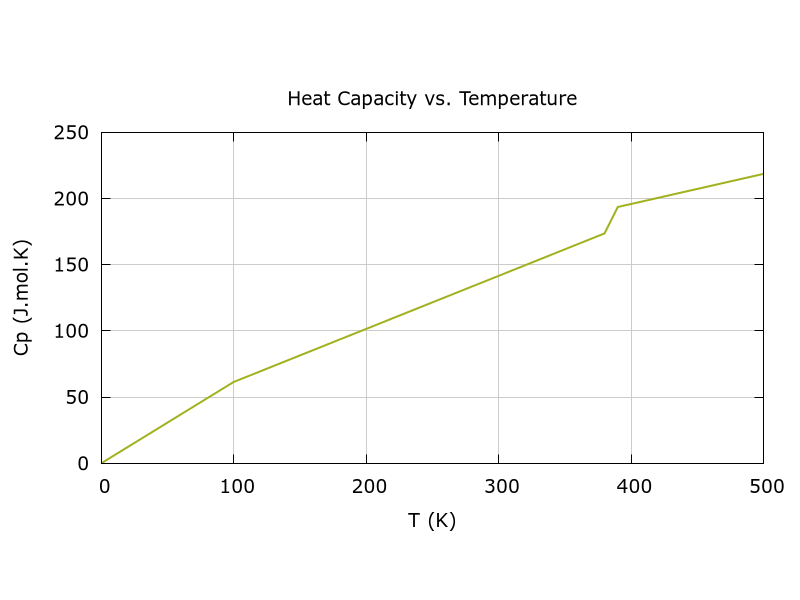
Heat capacity as a function of temperature for polystyrene.
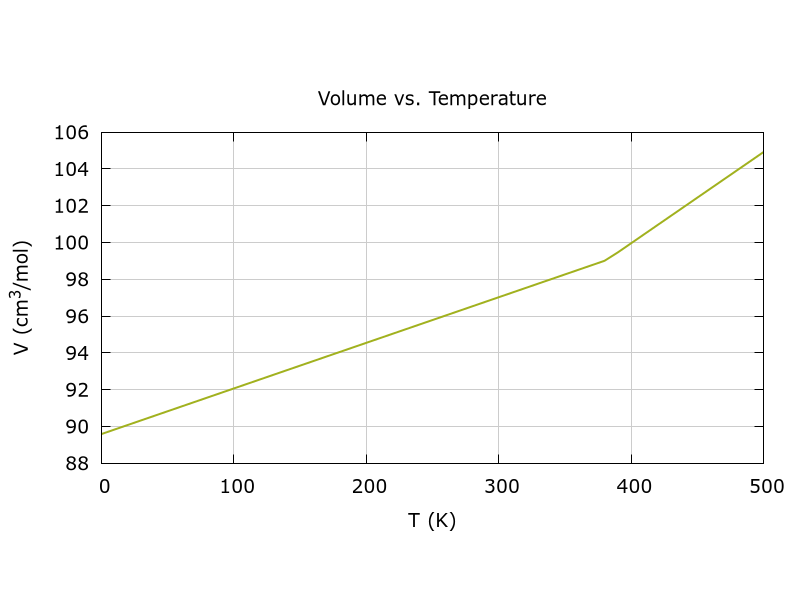
Specific volume as a function of temperature for polystyrene. The glass transition temperature (at approximately 373K) is clearly evident.
Copolymer Properties
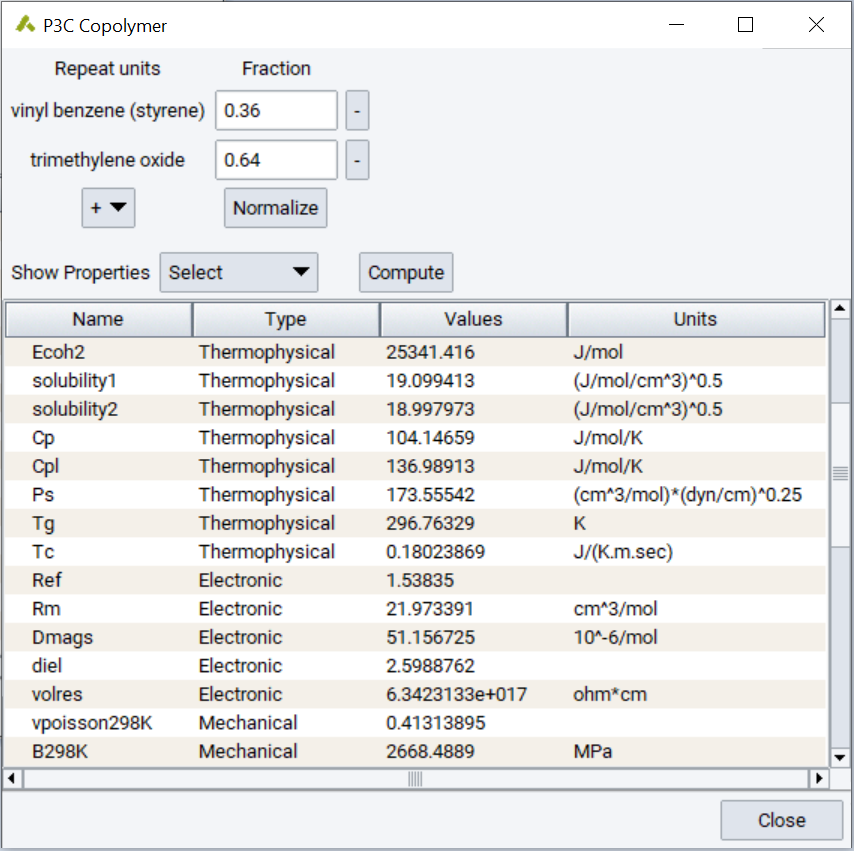
Interactively computing the properties of an amorphous random copolymer of vinyl benzene (styrene) and trimethylene oxide.
MedeA P3C can be used to compute the properties of copolymers, using the methodology described in Chapter 18 of ‘Prediction of Polymer Properties’ [2]. The properties computed for copolymers are: glass transition temperature (Tg), temperature of half decomposition (Td12), Coefficient of thermal expansion (aT), Density, specific heat capacity (cp), solubility parameter (solubility1), surface tension (g1), refractive index (Ref), dielectric constant (diel), Poisson’s ratio (vpoisson298K), bulk modulus (B298K), Young’s modulus (Eyoung298K), shear modulus (Gshear298K), Brittle fracture stress (Bf298K), Shear yield stress (Sy298K), activation energy for viscous flow at zero flow rate (Eavis), O2 permeability (PO2), CO2 permeability (PCO2), and thermal conductivity (Tc).
As discussed in ‘Prediction of Polymer Properties’, the most instructive heat capacity property for copolymer systems is the specific heat capacity, cp, with units J/(g.K) i.e. the heat capacity normalized by unit weight).
Applications
As noted, the MedeA P3C methodology is widely employed in polymer research. A search of the patent and patent application literature reveals several hundred patents that employ the method in computing and understanding polymer properties (see, for example, this patent query).
Example applications include the development of flame retardants [3], cosmetics [4], electronics [5], coatings [6], and photoresists [7].
Summary
MedeA P3C bridges chemistry and performance by translating repeat-unit structure into actionable property data, making it easier to optimize polymers for applications such as packaging, electronics, coatings, and high-performance structural materials.
Key Features
Reports extensive and reliable physical properties for polymer systems
Supports interactive updates as structural modifications are made
Computes the properties of sets of polymers using MedeA Flowcharts
Provides access to property descriptors to create custom correlations
Computes the properties of random copolymers as well as homopolymers
Reports descriptors and computes properties for use in MedeA Flowcharts
Provides temperature dependent property graphs for many properties
Required Modules
MedeA Environment
Find Out More
Learn how MedeA P3C provides polymer properties and materials design insights in the Materials Design Application Notes:
Computing Polymer Properties Using Correlations
Learn more about building repeat units in MedeA here: How to Build a Polymer with Customized Repeat Unit
Learn about building extended polymer models in this online tutorial: How to Build a Polymer
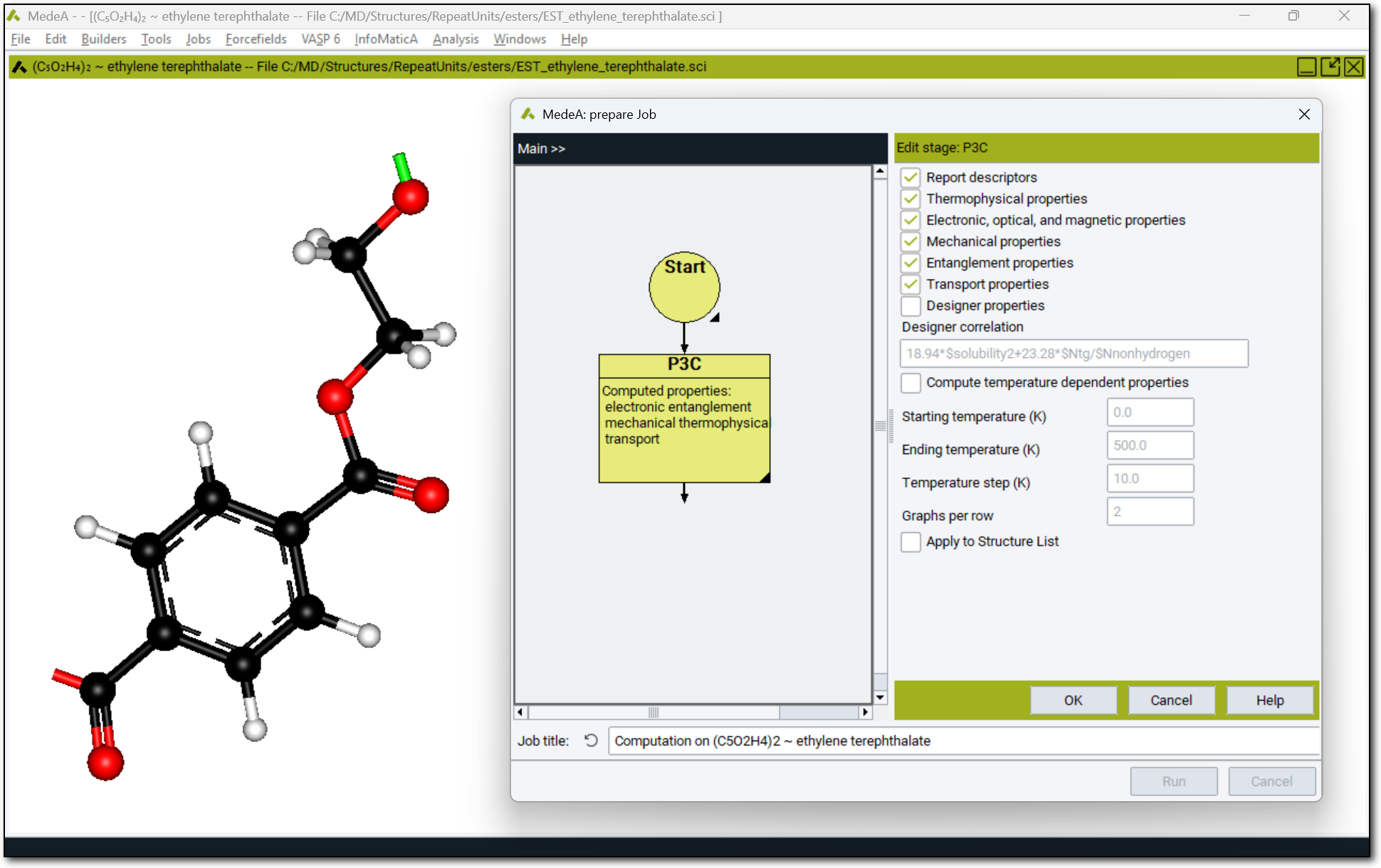
MedeA P3C is available as a Flowchart stage which also provides access to all properties and descriptors for any given repeat unit. Additionally, designer correlations and temperature dependent properties are supported.
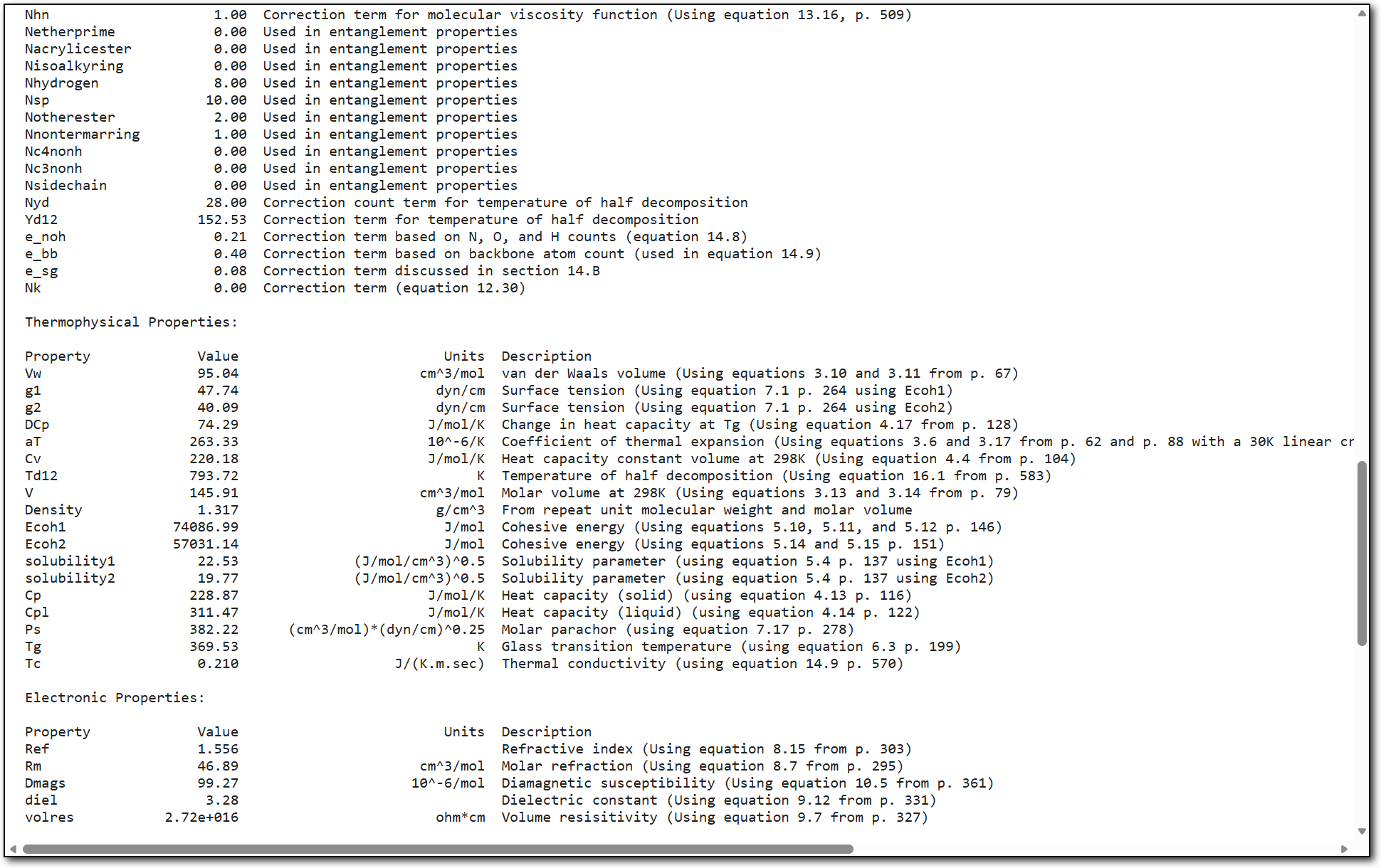
MedeA P3C Flowchart output, with properties and descriptors, is readily accessible via the MedeA JobServer.
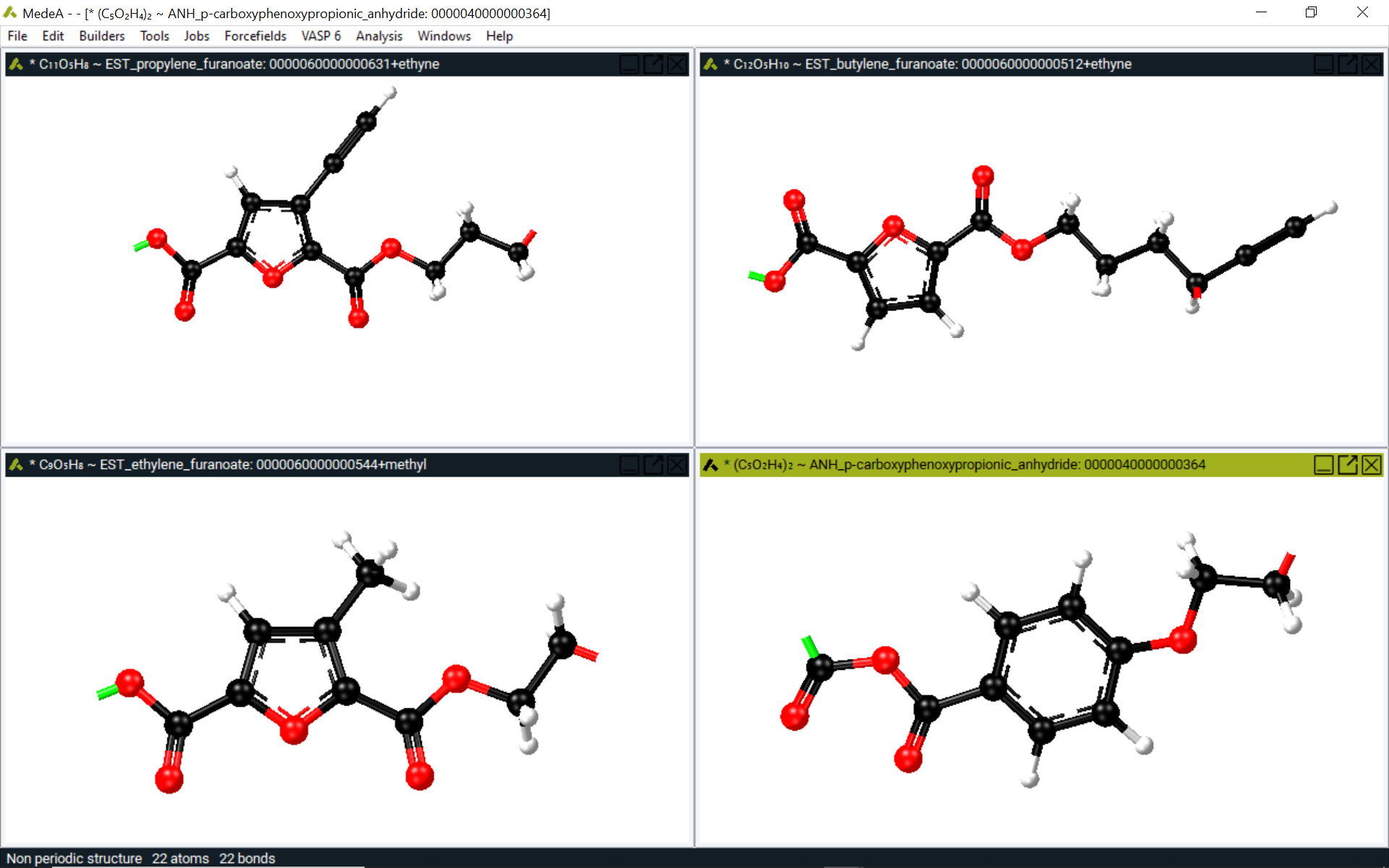
Repeat units for polymers with multiple oxygens (red atoms) and aromatic moieties, including furanoate (furan-2,5-dicarboxylate). MedeA P3C can be used to evaluate and explore the properties of such repeat units interactively.
- download: