MedeA Mechanical Properties (MT) - Explore Elastic Response and Mechanical Stability of Materials
At-a-Glance
MedeA®[1] MT highly efficiently and effectively calculates key mechanical and thermodynamic properties of metals, semiconductors, ceramics, glasses, polymers, and thermosets.
Key Benefits
Fully automated and robust computational procedure, designed to achieve utmost accuracy for the elastic coefficients as compared to other available approaches
Automatic prediction of a wealth of derived, technologically important data, such as stability analysis, polycrystalline moduli, descriptors for hardness and ductility, Debye temperature, and estimates for the thermodynamic functions
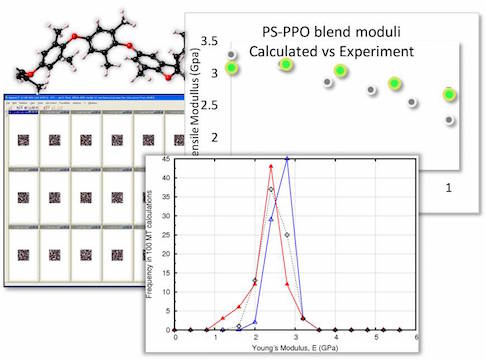
Statistically rational results, especially for polymers, thermosets, and amorphous systems
Straightforward combination of different computational approaches in a single workflow
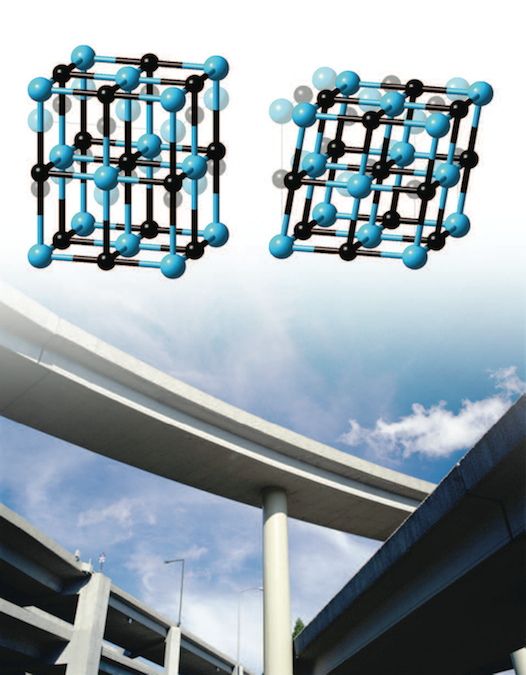
By means of a fully automated procedure evaluating the elastic response to lattice distortions [2], MedeA Mechanical Properties (MT) calculates mechanical and thermodynamic properties of crystalline, polycrystalline, and amorphous materials. Especially, for amorphous materials MedeA Mechanical Properties (MT) precisely and quantitatively predicts elastic properties by means of statistical sampling within the Hill-Walpole approach, as improved by Suter and Eichinger. [3]
The symmetry generality of the approach described here enabled the creation of a robust user interface going seamlessly from the database search to the printout of the elastic coefficients. With it, even nonspecialist users can reliably produce technologically relevant results…
Yvon LePage and Paul Saxe (abstract of [2])
Properties from MedeA Mechanical Properties (MT)
Elastic coefficients with estimation of numerical uncertainty
Mechanical stability analysis, using the eigenvalues of the elastic coefficient matrix
Elastic moduli (bulk, shear, and Young’s moduli) from polycrystalline averaging (Voigt, Reuss, and Hill)
Precise bounds estimate for elastic properties of polymers and glasses
Poisson’s ratio, Pugh’s ratio, and Vickers hardness as descriptors for Poisson effect, ductility, and hardness
Velocity of sound
Debye temperature
Temperature dependent thermodynamic functions calculated within the Debye model
Heat capacity
Zero-point energy
Vibrational enthalpy, entropy, and free energy
Temperature dependent thermal expansion coefficient estimated from Debye-Grüneisen approach
Computational Characteristics
Predicts key mechanical properties within the elastic regime
Automatic detection and use of any space-group symmetry
Iterative full relaxation of all atomic degrees of freedom of distorted structures resulting in utmost accuracy (as compared to exploiting the Hessian only once)
Supported compute engines for optimization and stress tensor evaluation
MedeA VASP: recommended for metals, semiconductors, ceramics, and molecular crystals
MedeA LAMMPS: recommended for polymers and thermosets, and amorphous materials
MedeA MOPAC: recommended for molecular crystals
Determination of minimum set of elastic coefficients, compliances, and their matrices
Together with MedeA HT-Launchpad, configurational sampling and improved Hill-Walpole bounds analysis for polymers, thermosets, and amorphous systems build with MedeA Amorphous Materials Builder.
Exhaustive use of methods available in MedeA VASP, such as LDA, GGA, GGA+U, meta-GGA, van der Waals, and hybrid functionals, spin-polarization, and fully relativistic Hamiltonians
Fully automated setup, execution, and processing of calculations with any of the recommended compute engines
Restart capabilities in case of hardware or any other failures
Required Modules
MedeA Environment
MedeA Mechanical Properties (MT)
Recommended Modules
MedeA VASP
MedeA LAMMPS (Part of the standard MedeA Environment)
MedeA MOPAC
MedeA HT-Launchpad
MedeA HT-Descriptors
MedeA Amorphous Materials Builder
MedeA Pearson
Find Out More
Watch the Webinar: Predicting Elastic Properties Using Ab Initio and Forcefield Based Simulations
Learn how to calculate elastic constants with MedeA VASP and MedeA LAMMPS in these tutorials:
Applications of MedeA Mechanical Properties (MT) are demonstrated in the following Materials Design Application Notes:
Stability of Alkaline-Earth Hydrides
Elastic coefficients and moduli for silicon carbide (\(\beta\) -SiC), corundum (\(\alpha\)-Al2O3), and ferric tourmaline (schörl)
Change of Elastic Properties of Graphite Electrode upon Li Intercalation
Effect of Resin Molecular Architecture on Epoxy Thermoset Mechanical Properties
- download: