MedeA MOPAC - Reliable High-Throughput Calculations of Thermodynamic Properties
At-a-Glance
Full integration of the quantum chemistry engine MOPAC (Molecular Orbital PACkage) within the MedeA®[1] Environment to perform more property calculations for molecules and solids of several thousands atoms faster.
Key Benefits
Rapid and reliable thermodynamic property calculations of single molecules and crystal structures
Accurate property predictions for organic and inorganic systems with hundreds to thousands of atoms
Swift input generations due to excellent structure building features and structure libraries of MedeA
Streamlined property screening for thousands of compounds
Developed and Improved over Decades
MOPAC is a semi-empirical quantum chemistry software based on the Dewar and Thiels NDDO approximation that was introduced in the 1980’s. Since then, the main developer Jimmy Stewart has constantly improved MOPAC such that properties are highly efficiently calculated with experimantal accuracy [2]. The most recent approaches that were implemented (PM6, PM7) are as accurate as density functional (DFT) methods but significantly faster [3].
The impressive performance of MOPAC is especially true for thermodynamic properties of organic molecular systems as well as crystals of inorganic compounds (excluding metals) [4].
MOPAC 2016, takes full advantage of new hardware architectures to further reduce computer time. The application range of MOPAC is very broad, comparable to DFT methods and much more versatile than approaches that use forcefields.
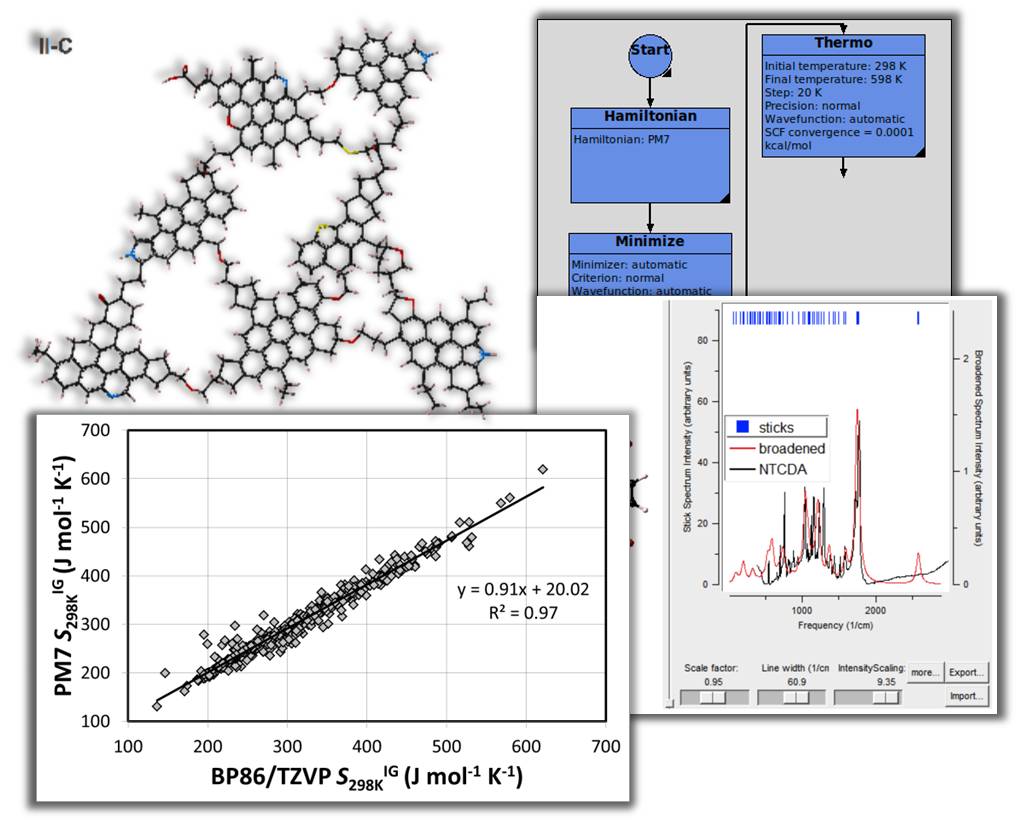
MedeA MOPAC - Calculate properties of molecules with flowcharts to compare results with experimental data.
Key Features
Accurate predictions of properties for non-metallic systems
More than one order of magnetide faster than standard DFT methods
Implemented semi-empirical methods: AM1, MNDO, MNDOD, PM3, PM6, PM7, and RM1
Combinable and compatible with MedeA LAMMPS and MedeA VASP
Why use Semiempirical methods? Modern methods have good accuracy, results can be rapidly checked, and ideas can be tested easily. We want to solve a problem!
Jimmy Stewart
Properties
Heat of formation
Reaction energy and Gibbs free energy
Solvation energy (COSMO)
IR/Raman spectra
UV/Vis spectra
Molecule volume and area
Dipole moment
HOMO/LUMO band gap
Required MedeA Modules
MedeA Environment
MedeA MOPAC
Recommended MedeA Modules
MedeA Amorphous Materials Builder
MedeA Docking
MedeA GIBBS
MedeA Gaussian GUI
MedeA HT-Launchpad
MedeA HT-Descriptors
MedeA QT
Find Out More
Learn more about how MOPAC can be employed in the following Materials Design Application Notes:
Energies of stable conformers in heavy alkanes and triglycerides using MedeA
Properties of natural gases in classical and in HP-HT conditions
Prediction of ideal heat capacity, Cp,id(T), of alkanolamines and amides: a combined QM-QSPR approach
Prediction of vapor-liquid equilibrium (VLE) properties of cyclic and polycyclic compounds from Gibbs ensemble simulations
- download: