MedeA Machine-Learned Potential Generator
At-a-Glance
The MedeA®[1] MLPG (Machine-Learned Potential Generator) enables users to create their own machine-learned potentials from training-set data previously generated by quantum mechanical calculations. The resulting potentials allow users to perform simulations of systems substantially larger in size and for much larger simulation times than can be typically accessed using quantum mechanical methods while at the same time reflecting the high accuracy and validity of the latter.
In addition to managing selection of training and validation data, the MedeA Machine-Learned Potential Generator allows you to generate machine-learned potentials, using the Spectral Neighbor Analysis Potential (SNAP) [2], Neural Network Potentials (NNP) [3], the Atomic Cluster Expansion (ACE) [4], or the GRaph Atomic Cluster Expansion (GRACE) formalism [5]. The potentials created are ready for subsequent use with MedeA Machine-Learned Potential. Combined with the MedeA Flowchart interface as well as VASP and LAMMPS, the MedeA Machine-Learned Potential Generator thus provides efficient access to machine learning based simulation techniques.
Key Benefits
Productivity
Automates the creation of machine-learned potentials using the SNAP, NNP, ACE, or GRACE formalism
Extends ab initio precision to larger length and time scales
Manages training set data
Full Ziegler-Biersack-Littmark (ZBL) potential support of the SNAP approach
Accuracy
Provides access to all calculation details and information
Provides MLPs for use with all MedeA LAMMPS property calculation types
Machine-learned potentials employ efficient descriptors of atomic environments combined with machine learning based correlative methods to describe the energetic behavior of atomic and molecular systems. The MedeA Machine-Learned Potential Generator allows users to generate machine-learned potentials by accurately reproducing supplied target first-principles data for a training set of structures.
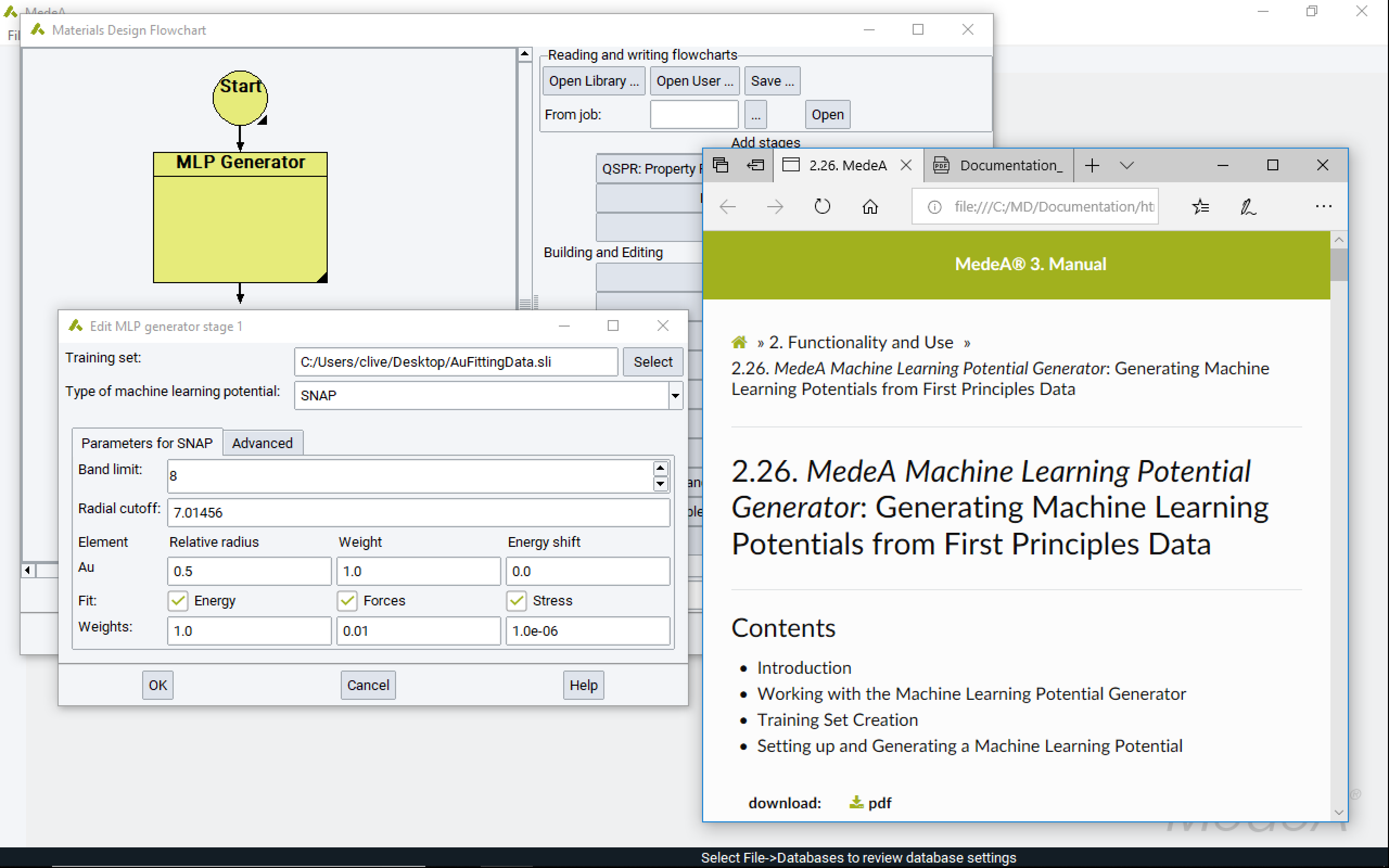
The MedeA Machine-Learned Potential Generator (MLPG) is integrated within the MedeA environment allowing straightforward use of first-principles information from VASP in the creation of MLPs.
The MedeA Machine-Learned Potential Generator manages training-set data derived from first-principles calculations as the target to be reproduced by the MLP. Configuration dependent energies, forces, and stresses can be considered in the fitting process. Using the SNAP, NNP, ACE, or GRACE approach the MedeA Machine-Learned Potential Generator creates a machine-learned potential by minimizing the deviations from the target energies, forces, and stresses calculated by quantum mechanical methods. While this process is guided by meaningful default parameters, the full flexibility of the underlying methods can be accessed by advanced settings. The MedeA Machine-Learned Potential Generator has been developed as part of active research and development projects and is thoroughly validated.
Desired target data for a given system are collected in the form of a MedeA structure list. The resulting library of information can, for example, contain configurations with only small deviations from the respective ground-state structures or structures obtained from high-temperature ab initio molecular dynamics simulations. Based on this sampling of the configuration space for the desired system, the MedeA Machine-Learned Potential Generator adjusts selected machine learning parameters to reproduce the quantum mechanical results. This guarantees maintaining the high accuracy and validity of the latter.
The MedeA Machine-Learned Potential Generator provides detailed analytical output, including automated graphical analysis of the degree of fit of the optimized description and supplied target information. The derived MLP is saved in an .frc file that can be further employed in the MedeA simulation and JobServer environment.
The MedeA Machine-Learned Potential Generator with the SNAP formalism also supports the Ziegler-Biersack-Littmark (ZBL) short-range interaction potential, this facilitates simulation of ion implantation and radiation damage, for example.
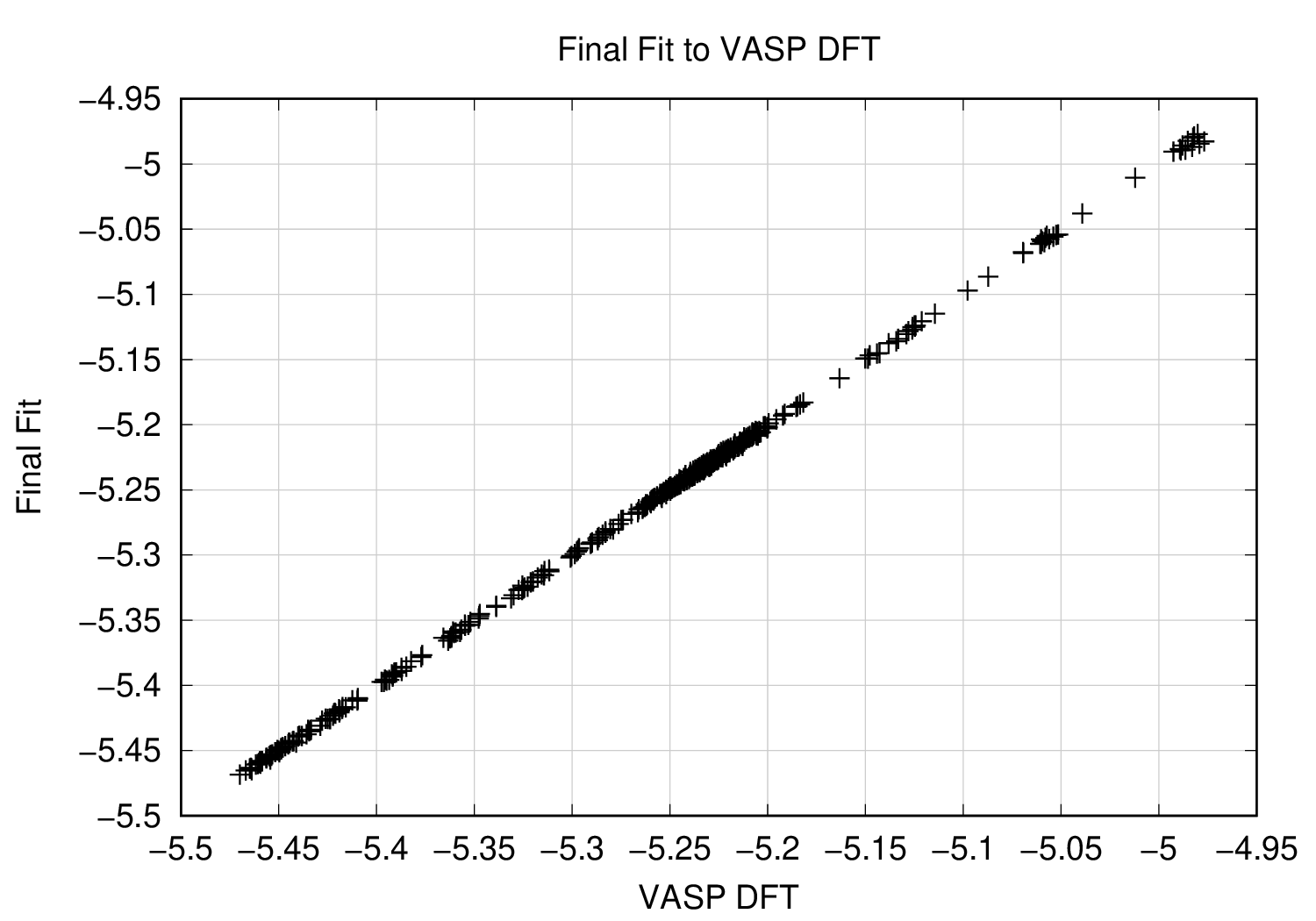
Comparison of VASP and SNAP energies for a particular system’s training set.
Technical Features
User Interface
Selection of training and validation data
Specification of terms for optimization
Report and plot creation for analysis
Supported Target Data
Energies, forces, and stresses
Key Features
Uses VASP derived DFT results
Interactive selection and control
Automated results analysis
Efficient handling of optimization
Required Modules
MedeA Environment
MedeA Machine-Learned Potential Generator
MedeA Machine-Learned Potential
MedeA VASP
MedeA LAMMPS (Part of the standard MedeA Environment)
Find Out More
Learn more about Machine Learning by watching the webinar: https://www.materialsdesign.com/webinars/recorded/mlp-surpassing-the-limits-of-ab-initio
- download: