MedeA Surface Tension - Ease the Tension in Surface/Interfacial Tension Calculations
At-a-Glance
The MedeA®[1] Surface Tension module enables users to compute the surface and interfacial tension of a range of liquids, molten materials, and interfaces.
The underlying methodology computes the the difference between the average time of the stress components perpendicular and tangential to a liquid simulation slab.
Key Benefits
Provides automated setup, execution, and analysis of LAMMPS molecular dynamics simulations for surface and interfacial tension calculations
Handles model construction and assignment of forcefield atom types and charges in one unified environment so there is no need to use external tools
Performs analysis of surface/interfacial tension with graphs showing convergence for a given simulation
Computational Characteristics
MedeA Surface Tension module uses the LAMMPS classical molecular dynamics engine for efficient performance on computers from scalar workstations to massively parallel supercomputers.
Accuracy depends on the quality of the employed forcefield. Use any of the supported forcefields in MedeA, import forcefields from literature, or even develop your own with MedeA Forcefield Optimizer.
Works seamlessly with high-throughput techniques enabled by MedeA HT-Launchpad module to screen large number of design options of interfaces before committing to experiments.
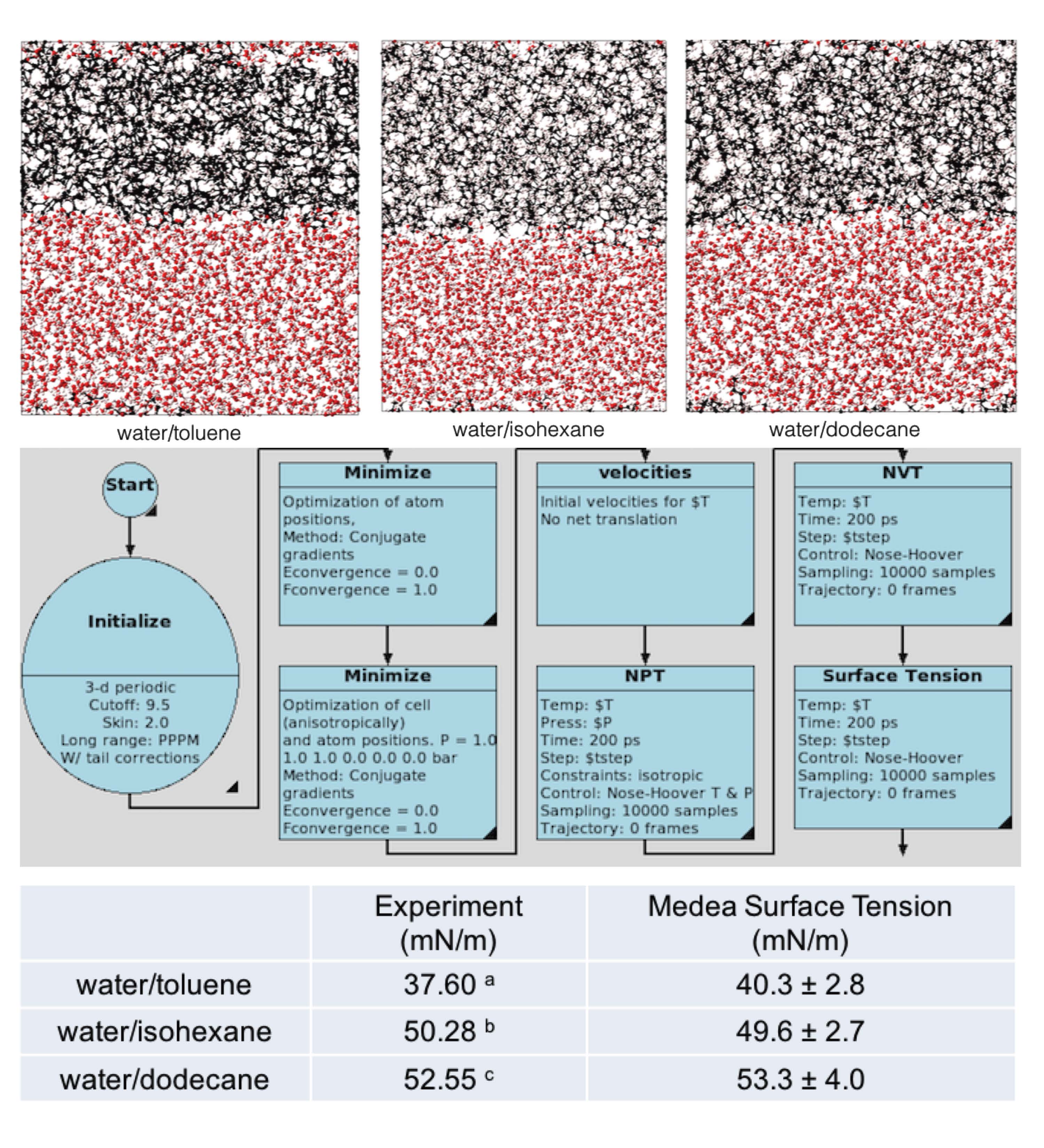
Interfacial tension of water/isohexane, water/toluene, and water/dodecane interfaces from MedeA Surface Tension module using pcff+ forcefield compared to experimental values
The Medea Surface Tension module provides automated preparation, execution, and analysis of surface tension calculations - so you can focus on the science
Required Modules
MedeA Environment
MedeA LAMMPS (Part of the standard MedeA Environment)
MedeA Surface Tension
Recommended Modules
MedeA Amorphous Materials Builder
MedeA Diffusion
MedeA Thermal Conductivity
MedeA Viscosity
MedeA Forcefield Optimizer
MedeA HT-Launchpad
Find Out More
Learn more about the MedeA Surface Tension module from our Materials Design Tutorials page or by contacting info@materialsdesign.com:
Interfacial Tension of Water and Organic Solvent Interfaces
- download: