MedeA EAM - Easy Access to Powerful Simulations of Metallic Systems
✓ Part of the standard MedeA Environment
At-a-Glance
Embedded Atom Method (EAM) forcefield based simulations provide computationally efficient descriptions of structural, mechanical, and thermal properties of metallic systems. The MedeA®[1] EAM module provides straightforward access to EAM simulations in the MedeA Environment.
Key Benefits
Productivity - Fully utilizes the powerful LAMMPS simulation workflows within the MedeA Environment
Coverage - Supports a wide range of properties for meteallic systems:
Structures
Energetics and structural properties of defects
Mechanical properties
Dynamical properties, such as melting points
Flexibility - Incorporates an extensive set of models:
Load models from MedeA InfoMaticA
Use the MedeA Amorphous Materials Builder to create models
Modify models with the powerful, yet intuitive simulation protocols of MedeA Flowcharts
Perform large scale simulations of metallic systems, spanning significant time scales using MedeA EAM
Key Features
Support for Finnis-Sinclair format EAM forcefield files with simple extensions for template type assignment and referencing
Support for atom type assignment template rules to facilitate construct-then-type model constructions for LAMMPS simulations
Support for the Zhou et al 2004 [2] EAM parameterization supporting mixed alloys of: Cu, Ag, Au, Ni, Pd, Pt, Al, Pb, Fe, Mo, Ta, W, Mg, Co, Ti, and Zr
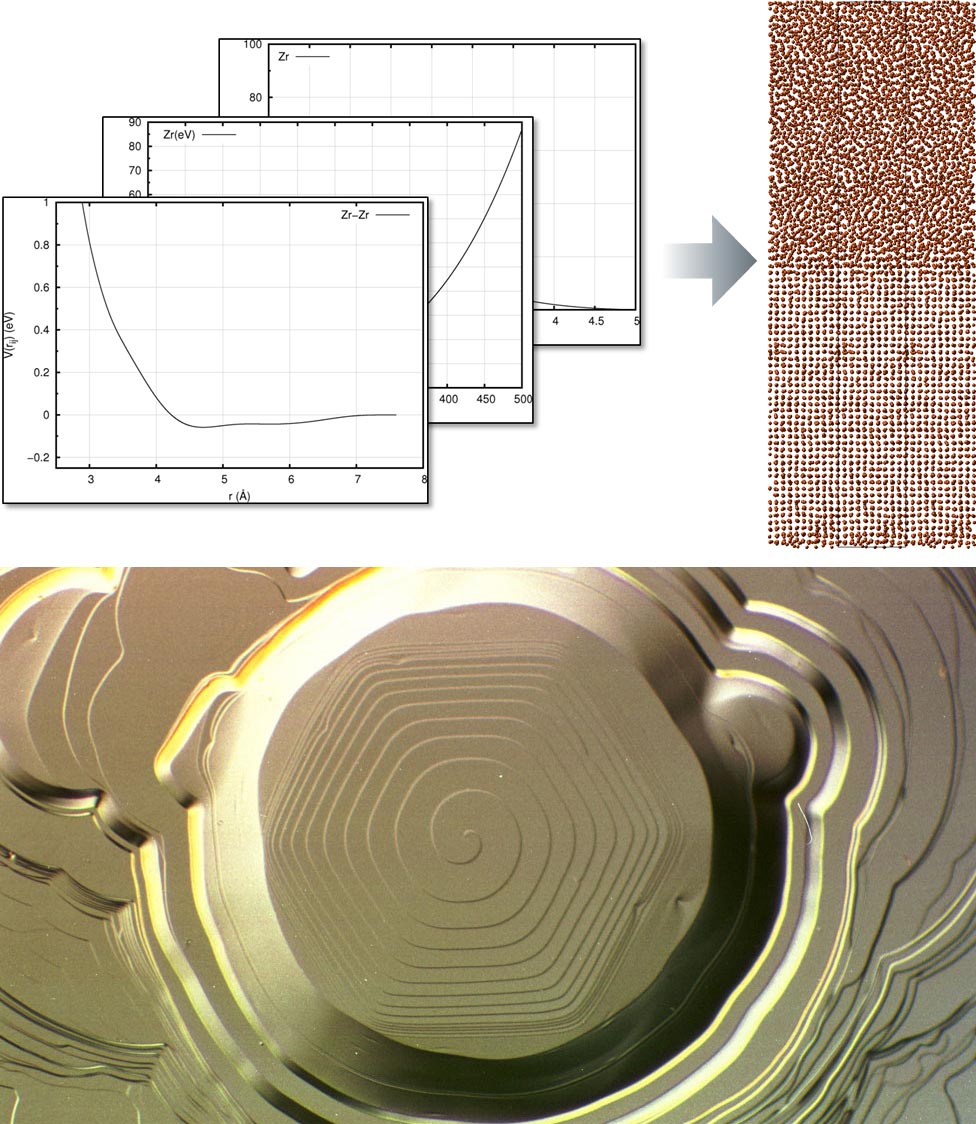
The upper section shows the simulation of the melting point of a metallic system using a two region model, and described by an EAM forcefield with component functions in the inset graphs. The lower section shows screw dislocations and other defects on a metal surface.
Required Modules
MedeA Environment
MedeA LAMMPS (Part of the standard MedeA Environment)
Find Out More
Visit the Materials Design Application Notes page to learn more about MedeA EAM from the following Application Note:
Embedded Atom Method (EAM) Simulations with MedeA
Watch the Materials Design online tutorial and learn How to Calculate Elastic Constants with LAMMPS
- download: