MedeA Diffusion - Reliable Mass Transport Properties from Classical Simulations
At-a-Glance
Diffusion plays a critical role in many materials related processes. For example, diffusion is centrally important in semiconductor manufacturing, the environmental degradation of structural materials, corrosion, and polymer permeability. The MedeA®[1] Diffusion module allows you to analyze simulation results by automatically calculating the diffusivity of selected species, while enabling direct observation of the diffusive behavior of different components.
Key Benefits
Automated plot creation facilitates analysis of calculation results
Visualization and confirmation of the presence of the diffusive dynamics regime through the provision of log(MSD) versus log(t) plots
Calculation of the mean square displacement (MSD) of selected atom sets
Determination of diffusion coefficients based on the Einstein diffusion equation
Evaluation of calculation uncertainties
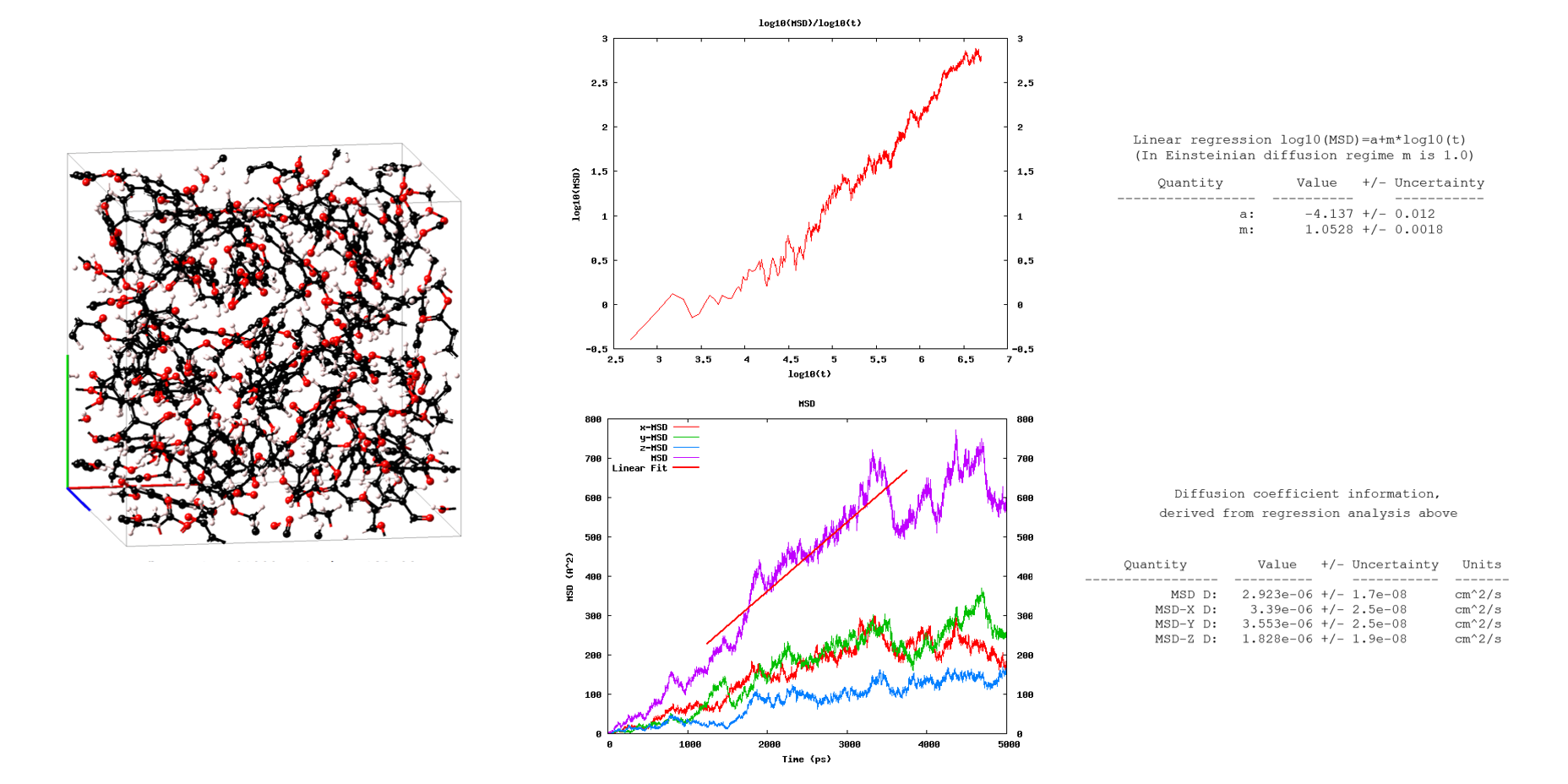
The mean square displacement (MSD) of 4 oxygen molecules in an amorphous polystyrene model at 550K (from the tutorial ‘Permeability of Oxygen in Polystyrene’). In addition to the complete MSD, spatially resolved MSDs are reported in each simulation direction, providing a visual indication of the degree of isotropy, and diffusive sampling, for a given system.
MedeA Diffusion is designed for materials scientists and computational chemists studying transport phenomena. Users include semiconductor and battery R&D teams studying ionic or molecular diffusion, polymer and coatings engineers evaluating permeability and barrier properties, and academic researchers validating forcefields and comparing experimental and simulated properties.
Computational Characteristics
Use the LAMMPS classical molecular dynamics engine for efficient performance on computers from scalar workstations to massively parallel supercomputers
Apply Medea Diffusion to polymers, molecular systems, metals, ceramics, interfaces, and confined systems.
Load models from the MedeA InfoMaticA databases or popular file formats, create them with the MedeA Amorphous Materials Builder, and even modify the models within simulation protocols of MedeA Flowcharts.
Define different atom sets using selection criteria based on atomic numbers, charges, forcefield atom types, names, and related characteristics.
Plug the MedeA Diffusion module into any LAMMPS simulation workflow. The MSD of selected atoms is computed with the microcanonical (NVE) ensemble. LAMMPS molecular dynamics and automated analysis of simulation results complete the workflow.
MedeA Diffusion supports diffusivity calculations of multiple species (subsets) in one stage, so you can easily examine the cross interactions between diffusing species.
Compute diffusion activation energy barriers and prefactors through the use of diffusivity simulations at multiple temperatures using the Arrhenius equation. Such calculations can be used to obtain diffusion coefficients even at temperatures where diffusion is limited on the molecular dynamics timescale.
Compute estimated uncertainties for calculated properties.
Use with a wide variety of forcefields including those based on embedded atom descriptions (EAM and MEAM forcefields), machine learned potentials (MLPs), Stillinger-Weber, Tersoff, and ReaxFF; and the highly accurate PCFF+ organic system forcefield developed by Materials Design.
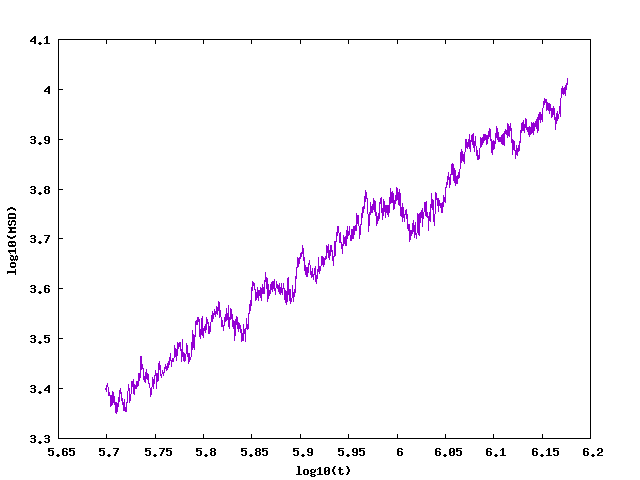
A log-log plot of mean square displacement (MSD) as a function of simulation time for 4 oxygen molecules in an amorphous polystyrene model at 550K (from the tutorial ‘Permeability of Oxygen in Polystyrene’).
Accelerate the prediction of mass transport properties with automated, validated diffusion analysis—directly from your molecular dynamics simulations.
Required Modules
MedeA Environment
MedeA Diffusion
MedeA LAMMPS (Part of the standard MedeA Environment)
Find Out More
Learn more about using MedeA Diffusion in these webinars:
Atomic-Scale Modeling With MedeA: A Path To Innovation In Batteries
Harness the Power of LAMMPS Molecular Dynamics Code with MedeA
Learn how MedeA Diffusion can be employed in the following tutorials:
Permeability of H2O in polyethylene terephthalate (PET)
Permeability of O2 in polystyrene (PS)
Absorption of O2 in polystyrene (PS)
See the Materials Design Application Notes page to learn about the application of MedeA Diffusion in the following application notes:
Self Diffusion of Argon
Self-Diffusion Coefficients for Pure Acetone and Toluene at Different Temperatures from Molecular Dynamics Simulations
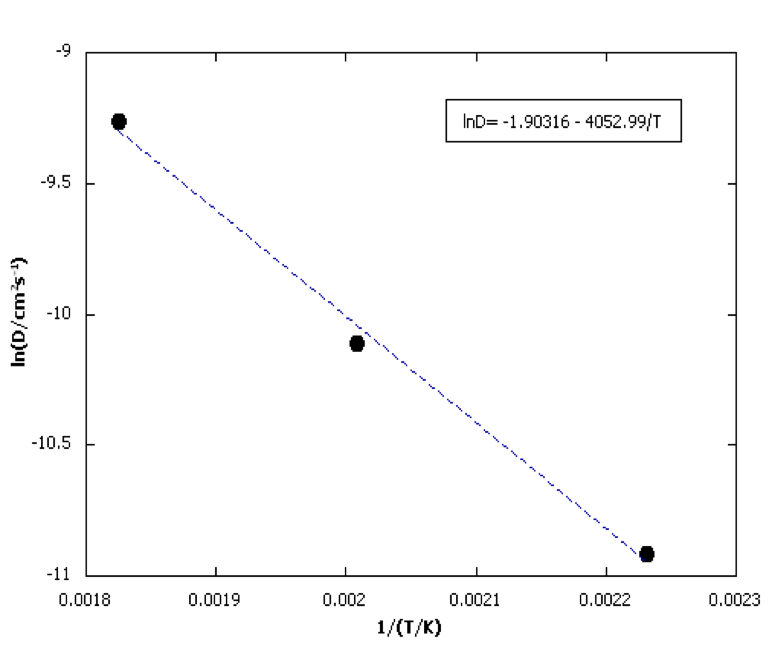
An Arrhenius plot for O2 in atactic polystyrene (548K-448K) yielding a diffusion coefficient of 1.87x10⁻⁷ cm2 s-1 at 298K, as obtained via linear extrapolation (from the tutorial ‘Permeability of Oxygen in Polystyrene’).
- download: