MedeA InfoMaticA - Rapid Access to Comprehensive Experimental Structure Data
✓ Part of the standard MedeA Environment
Rapid access to reliable experimental data is the foundation of materials science and technology, where in particular, crystallographic structural data are pivotal for atomic-scale understanding and simulations. MedeA®[1] InfoMaticA provides integrated search and retrieval capabilities of the world’s most comprehensive crystallographic structural databases.
At-a-Glance
MedeA InfoMaticA lets you rapidly access structure data and related property from the Inorganic Crystal Structure Database (ICSD), Pearson’s Crystal Data (Pearson), the NIST Crystal Database (NCD), and the Crystallography Open Database (COD). Collectively, these experimental databases contain well over 1.2 million entries. In addition, MedeA InfoMaticA allows for the construction of a custom, searchable structure database using computed properties.
Key Benefits
Brings an exhaustive experimental resource to your fingertips: together ICSD, Pearson, NCD and COD contain over 1.2 million organic and inorganic entries
Enhances your productivity through Cross-Database Search and Smart Grouping of Results
Provides direct input for simulations for any type of experimentally known crystal
The retrieval of a crystal structure from an experimental resource is often the first step in the modeling of a material. In fact, agreement of computed and experimental structural data of a model system is an excellent initial test of the validity of a chosen computational approach.
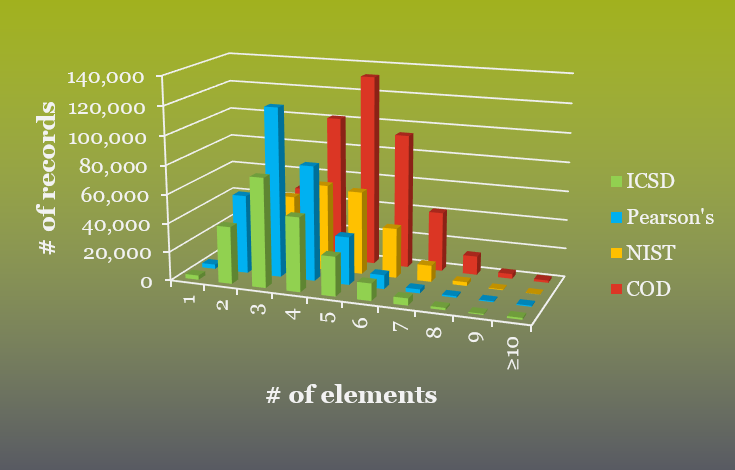
MedeA InfoMaticA - Number of records by constituent count and database
With MedeA InfoMaticA simultaneously search the databases, including user-created databases. Display the bibliographic reference and explanatory text. Retrieve, view, and modify 3-D atomistic models within the graphical user interface of MedeA. In addition, compute and display X-ray diffraction (XRD) powder patterns.
The world’s most comprehensive crystallographic structural databases at your fingertips.
Specifications
Graphical Database Search and Retrieval Interface, fully integrated with MedeA Environment
Configurable with major experimental structure databases (data on disk)
Inorganic Crystal Data (ICSD)
NIST Crystal Data (NCD)
Pearson’s datafile (Pearson)
Crystalline Open Database (COD)
Uses the Structured Query Search Language SQLite as the default database engine
Regular database updates in collaboration with database providers
Key Features
Uses an intuitive, menu-based query syntax, e.g. “Formula contains any number of transition metals” AND “Formula contains exactly 2 atoms of oxygen” AND “Formula does not contain hydrogen”
Smart function filters search results and arranges results by representative space group/symmetry
Comprehensive and flexible listing of experimental structure records: Tabulated, sortable by cell parameters, symmetry, reference, year, and much more
Provides full bibliographic references and direct input for simulations
Interactive, graphical display of chemical unit cell, geometry parameters and XRD powder pattern
Fully integrates with MedeA builders, property modules, and compute engines
Expandable with computed structure data and property data
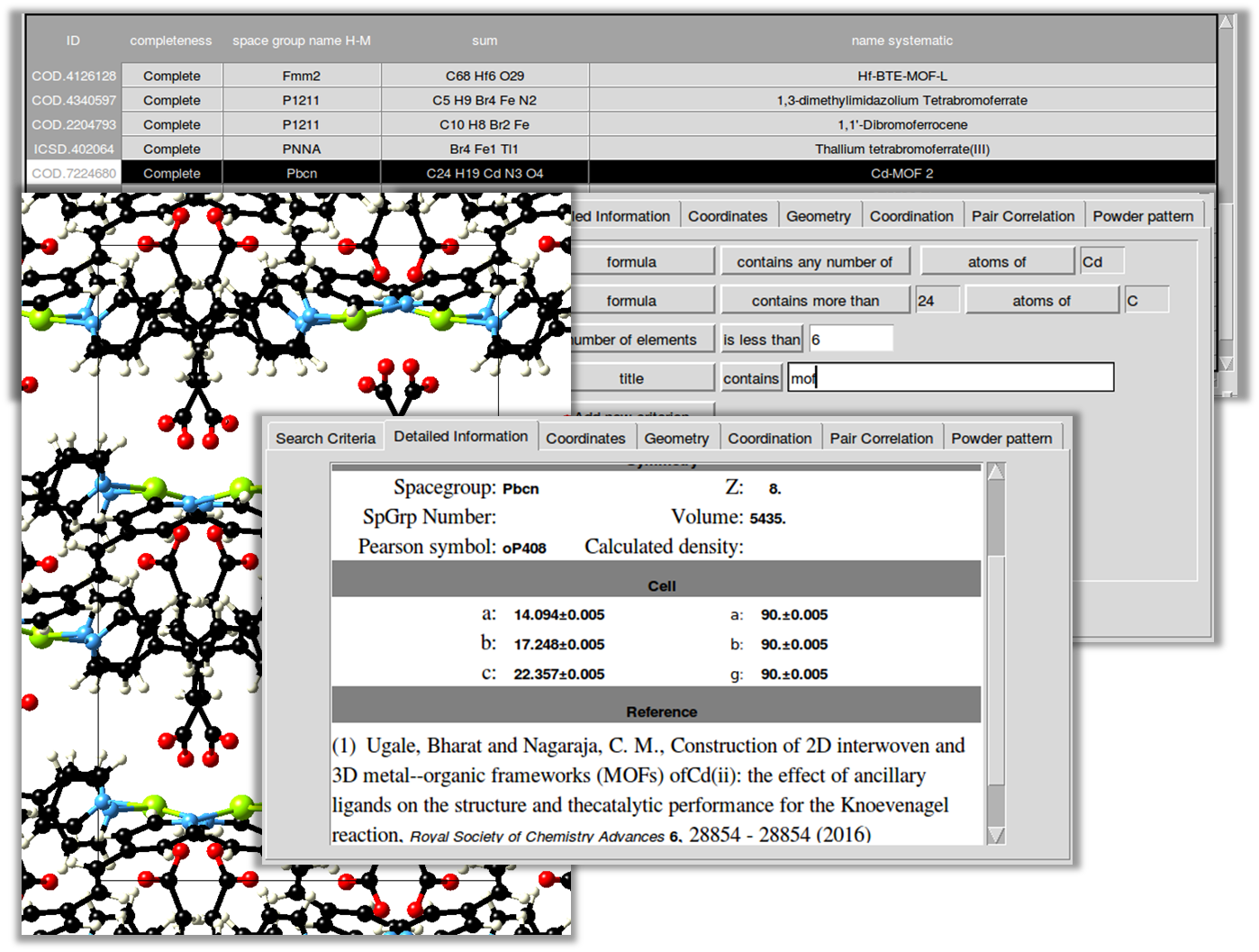
MedeA InfoMaticA Screenshot. Query fields with search criteria, tabulated results, and record-specific information
Properties
Ready-to-use structure models in the form of chemical unit cells
Lattice parameters, stoichiometry symmetry (space group)
Wyckoff positions, site occupancy
Atomic coordinates, interatomic distances and angles
Zoomable nearest neighbor plots and coordination number analysis
Pair correlation function
X-ray diffraction (XRD) powder pattern for varying radiation sources
Bibliographic reference, remarks on experimental setup (if present)
All properties can be used as search criteria
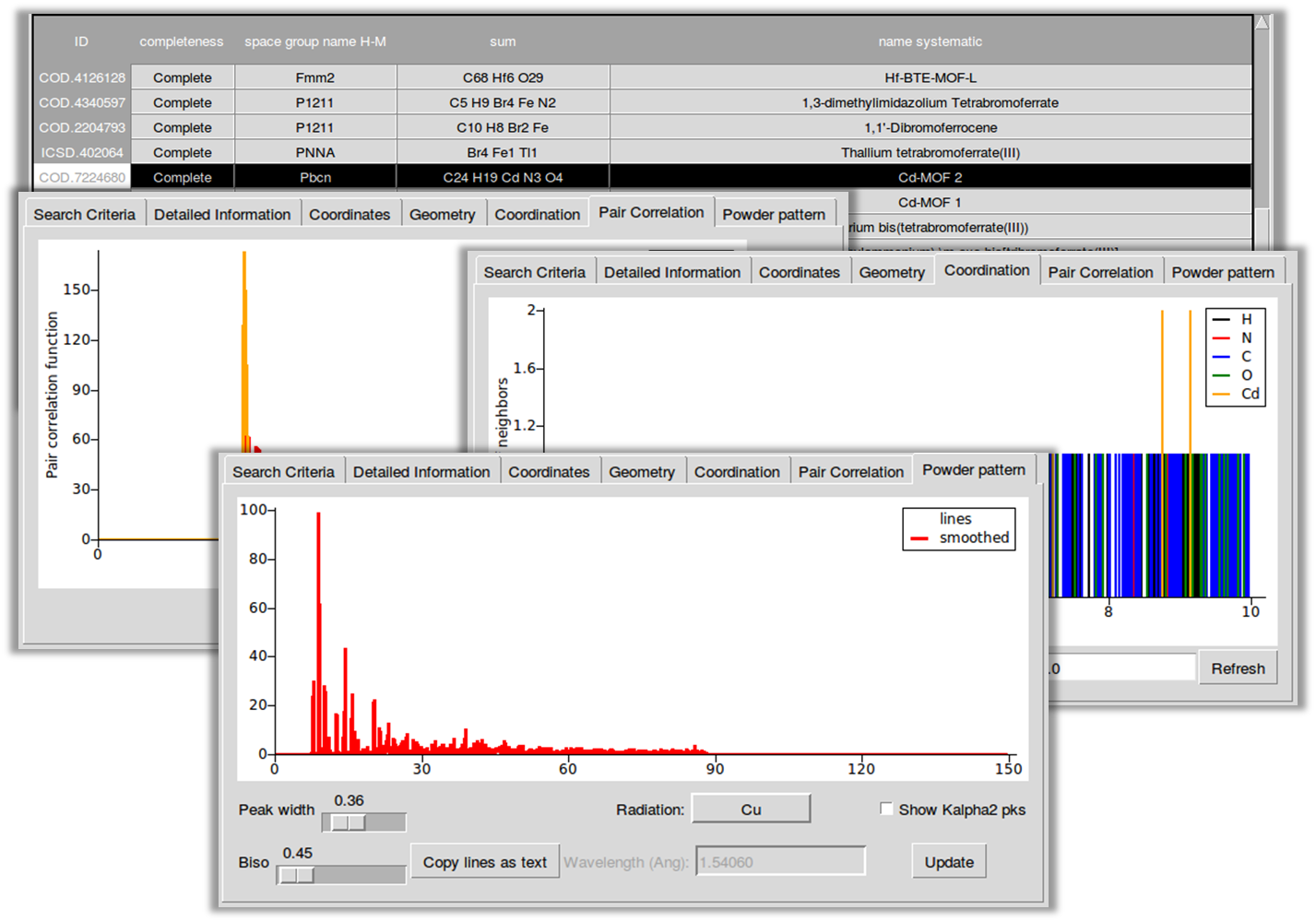
MedeA InfoMaticA Screenshot. Pair correlation function, atomic coordination, and XRD powder pattern
Required Modules
MedeA Environment
Recommended Modules
MedeA Pearson
MedeA ICSD
MedeA NCD
MedeA VASP
MedeA HT-Launchpad
Find Out More
MedeA InfoMaticA is the ideal starting point for building atomic structures of bulk phases with or without defects, surfaces, interfaces, etc. Learn more about MedeA InfoMaticA in the video tutorial: How to Calculate Elastic Constants with MedeA VASP on the Materials Design Youtube Channel.
- download: