MedeA GIBBS The Reference Approach for Fluid Properties and Sorption
At-a-Glance
MedeA®[1] GIBBS is one of the world’s leading forcefield-based Monte Carlo codes [2], used to predict and study [3]:
Fluid properties under various equilibrium conditions
Sorption in natural and industrial adsorbents (zeolites, MOFs, etc)
Solubility of small compounds in polymer materials
Ion exchange
Properties are provided with confidence intervals, offering validated predictions and insights to engineers.
Key Benefits
Advanced computational methods, such as statistical bias, allow simulation of complex molecules (polycyclic, branched, multi-functional)
Time-saving benefits using the pre/post-processing features of MedeA GIBBS GUI
Recommended hardware: cluster of multicore PC under Windows or Linux 64 bit.
Monte Carlo and Molecular Dynamics methods both sample the configurations of a molecular system. However, since Monte Carlo methods are stochastic while Molecular Dynamics methods are deterministic, the former are frequently more efficient at exploring configuration space and computing properties. In Monte Carlo simulations, depending on the statistical ensemble used, the number of molecules may vary in a given box. Several boxes, one per phase, are handled simultaneously when phase equilibrium is simulated [4]. These characteristics render Monte Carlo methods generally best suited for phase equilibria and sorption.
The MedeA GIBBS GUI offers advanced pre-processing, with built in know-how (e.g. system-adapted default Monte Carlo moves), as well as advanced post-processing.
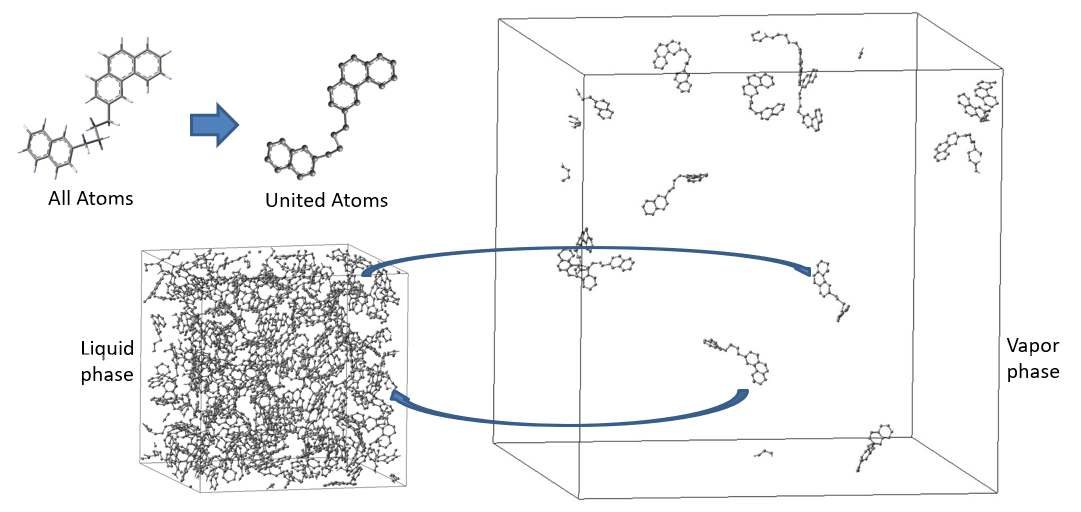
Schematic view of vapor-liquid equilibrium simulation of a polyaromatic hydrocarbons using the extended TraPPE-UA forcefield for polycyclic flexible molecules [5].
The laboratories devoted to data acquisition cannot face the increasing demand and molecular simulation appears to be the only valuable alternative to get these data before the deadline of the projects. (…) We are entering a cycle of data production and this is a very good piece of news for our industry.
François Montel, Thermodynamics expert, TOTAL (foreword of [2])
Predicted Properties
Thermodynamic: intermolecular energy, heat capacity, speed of sound, and Joule-Thomson coefficient
Volumetric: pressure/density, compressibility, and thermal expansivity
Vapor-liquid equilibrium of pure compounds: normal boiling temperature, vapor pressure, vaporization enthalpy, chemical potential, critical point, and acentric factor
Phase equilibrium of mixtures: bubble pressure, chemical potential, fugacity, density and composition of coexisting phases, and three phase vapor-liquid-liquid equilibrium
Fluid structure: radial distribution function and molecular conformations
Sorption: adsorption/desorption isotherms, differential enthalpy of adsorption, Henry solubility constants, sorption selectivity, and loading of cation location sites
Ion exchange in electrolytes or in microporous solids
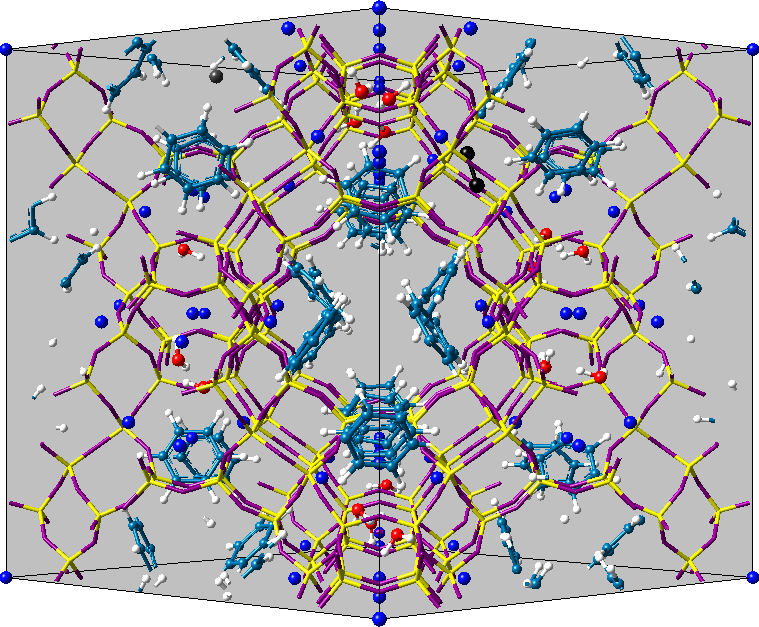
Example configuration of adsorption of a multicomponent gas mixture in NaY faujasite.
Forcefields
Various forcefields can be used:
Wide-purpose All Atom forcefields (pcff+, OPLSAA)
United Atom forcefields designed for fluid phase equilibria of flexible organic molecules (TraPPE-UA, AUA, Mie)
Specific rigid models for small organic and inorganic molecules (e.g.: H2O, N2, CO2, H2S) and solvated ions (e.g.: Na+, Li+, Cl-, F-)
Mie potentials for coarse-grained models of molecules
Specific forcefields for solid-fluid interactions in sorption: e.g. CLAYFF for clay minerals [6].
Value of Integration in MedeA
MedeA Forcefields integration provides easy and efficient forcefield assignment
MOPAC and Gaussian allow use of optimized molecular conformations and ideal gas properties
InfoMaticA provides access to crystal structures
VASP provides optimized structures and electrostatic energy grids for simulating sorption [7]
Amorphous Materials builder generates conformations of polymer materials used for simulating sorption
LAMMPS Diffusivity provides transport coefficients that may be combined with GIBBS predicted solubility to obtain membrane permeability of volatile compounds
Required Modules
MedeA Environment
MedeA GIBBS
Recommended Modules
MedeA Amorphous Materials Builder
MedeA VASP
MedeA MOPAC
MedeA Gaussian GUI
MedeA LAMMPS (Part of the standard MedeA Environment)
MedeA HT-Launchpad
Find Out More
Find out more about MedeA GIBBS in Materials Design Application Notes and Upcoming and Recorded Materials Design webinars.
- download: