MedeA Fermi Surface - Living on the Edge
At-a-Glance
MedeA®[1] Fermi Surface displays isosurfaces of electronic energies of metals, semiconductors, and insulators in k-space, and lists the effective masses of all bands at arbitrary k-points.
Key Benefits
Straightforward setup of the calculation
Automated distribution over a large number of tasks enables quick calculation
Easy selection of isosurface energy and isosurface sheets for display
Access to effective masses of all bands at any k-point
Allan Mackintosh’s suggestion to define a metal as ‘a solid with a Fermi surface’ underlines the importance of this quantity for a deeper understanding of materials’ properties [2]. It reflects the outstanding contribution electrons at (and within an energy range of kBT of) the Fermi surface make to a materials transport properties. In addition, the Fermi surface plays a paramount role in determining electronic system’s response to external perturbations and in indicating instabilities arising from interaction with the electrons’ spins or the vibrational degrees of freedom.
MedeA Fermi Surface thus provides ample insight into the ‘life on the edge’ [3]. Since this ‘edge’ can be shifted, even the isosurfaces at the full spectrum of metals and semiconductors are accessible with MedeA Fermi Surface.
As a simple example, the Fermi surface of Cu as shown in the below figure closely resembles the perfect spherical Fermi surface of a free electron band, but shows distinct deviations in the form of necks opening along the <111> directions. This is due to band distortions at the Brillouin-zone boundaries, caused by the real crystal potential. In general, calculated Fermi surfaces have a very high predictive power, and while confirming experimentally determined Fermi surfaces, e.g., by de Haas-van Alphen measurements or angle-resolved photoemission spectroscopy, facilitate interpretation of these data [4].
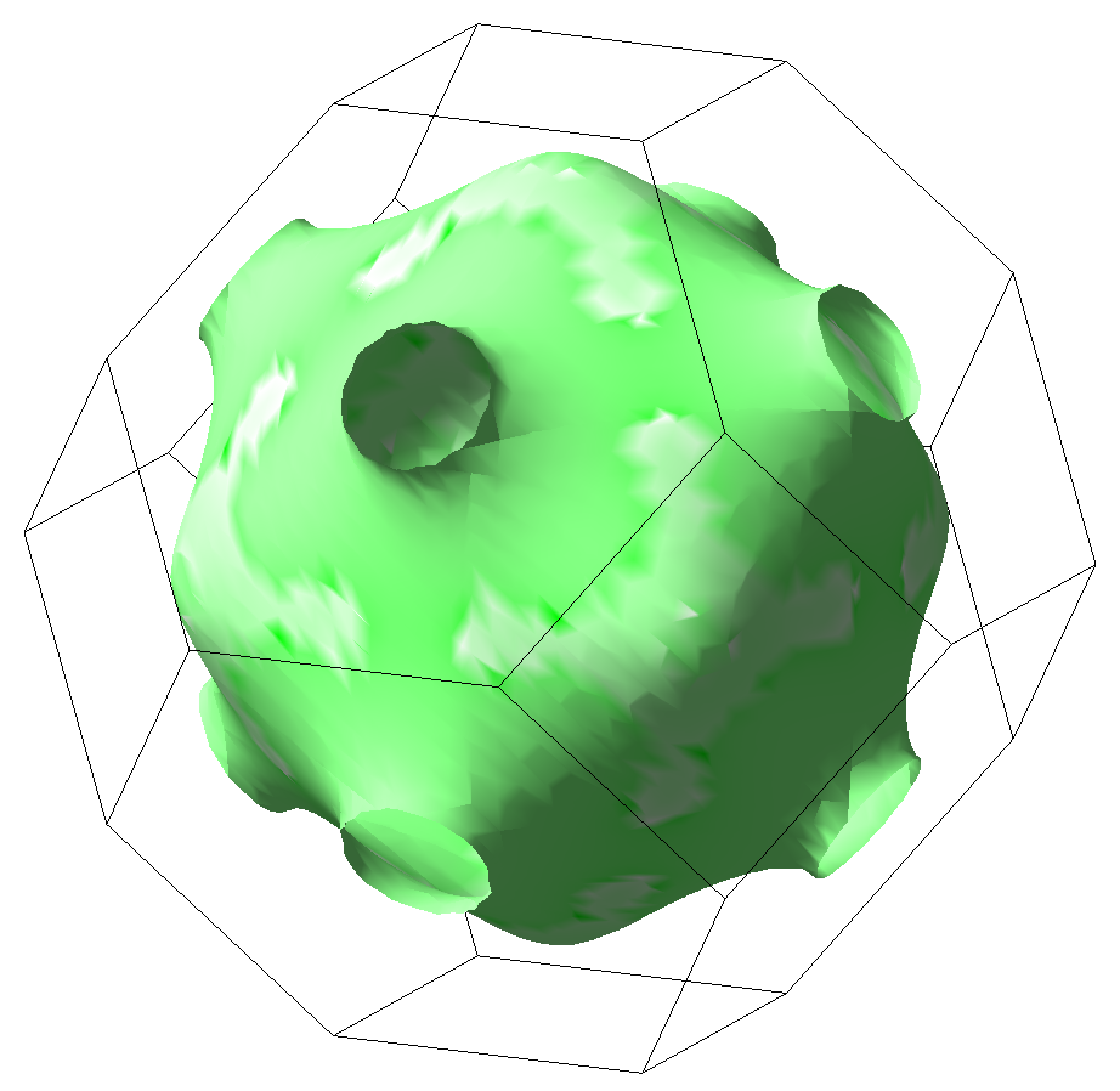
Fermi surface of Cu as calculated using MedeA Electronics.
The Fermi surface is the stage on which the ‘drama of the life of the electron’ is played out.
M. I. Kaganov and I. M. Lifshits, “Electron theory of metals and geometry”, Sov. Phys. Usp. 22, 904 (1979)
Key Features
An intuitive user interface allows completely automated setup, execution, and processing of the background jobs required to calculate isosurfaces of the electronic energies and the corresponding effective masses
Compute electronic eigenvalues with MedeA VASP
Apart from the calculational parameters of the underlying MedeA VASP calculation, MedeA Fermi Surface requires only specification of the fineness of the k-point grid used to display the isoenergy surfaces
Take advantage of the full integration in to the MedeA Environment and the robust insfrastructure of the MedeA JobServer and TaskServer.
Efficiently manage calculations in line with the computational resources
Automatically detect and use space-group symmetry
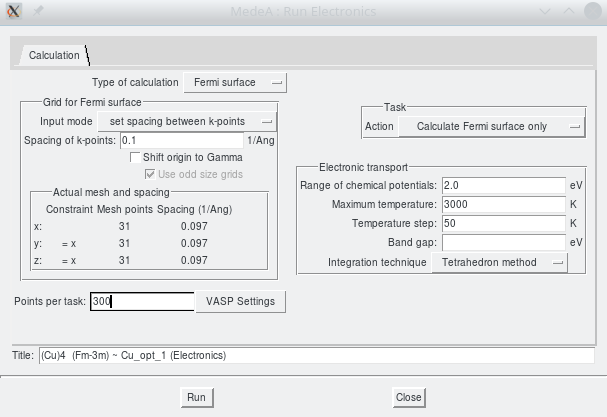
MedeA Fermi Surface Screenshot: Graphical user interface controlling setup of the calculation
Properties
Three-dimensional isosurfaces of electronic energies (Fermi surfaces) in k-space
Interactive analysis of effective masses for each band at any point in k-space
Interpolated electronic band structure displayed for orientation
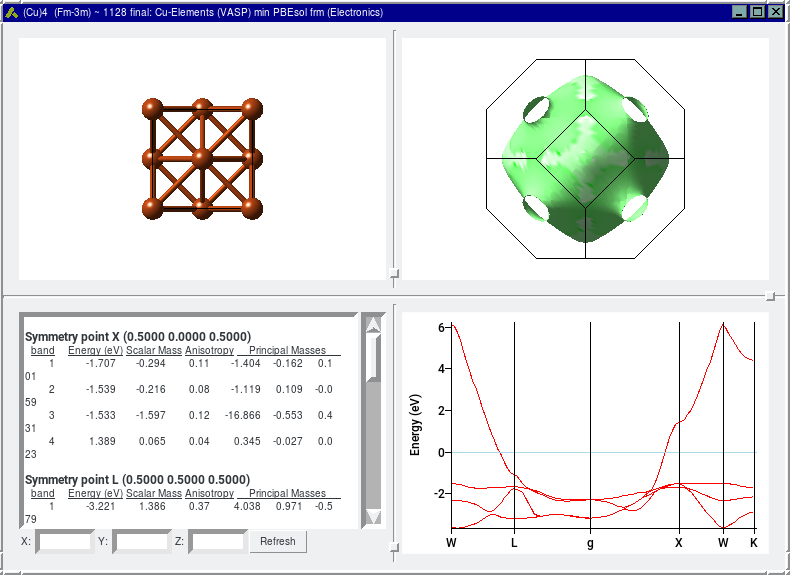
MedeA Fermi Surface Screenshot: Graphical user interfaces for the display and analysis of calculated Fermi surfaces and effective masses
Required Modules
MedeA Environment
MedeA VASP
MedeA Electronics
Find Out More
Check out the closely related datasheet on MedeA Electronic Transport.
- download: