MedeA Docking Create Host-Guest and Surface-Guest Models
At-a-Glance
MedeA®[1] Docking automatically creates, adjusts, and refines host-guest and surface-guest systems. Employing the well-known Metropolis Monte Carlo algorithm [2], MedeA Docking evaluates van der Waals interactions to generate and assess stable system configurations. The resulting host-guest structures may then be employed in forcefield and first-principles based simulations. MedeA Docking can be invoked interactively within the MedeA Environment or by using MedeA Flowcharts on the JobServer. MedeA Docking is a building tool that allows you to combine systems automatically to create the starting points for further simulation studies.
Key Benefits
Saves time through accelerated and automated model construction and refinement
Simplifies automated Flowchart based model construction for screening, allowing construction of host-guest and surface-guest systems without interactive manipulation
Explores multiple guest configurations, searching and evaluating many possible binding configurations
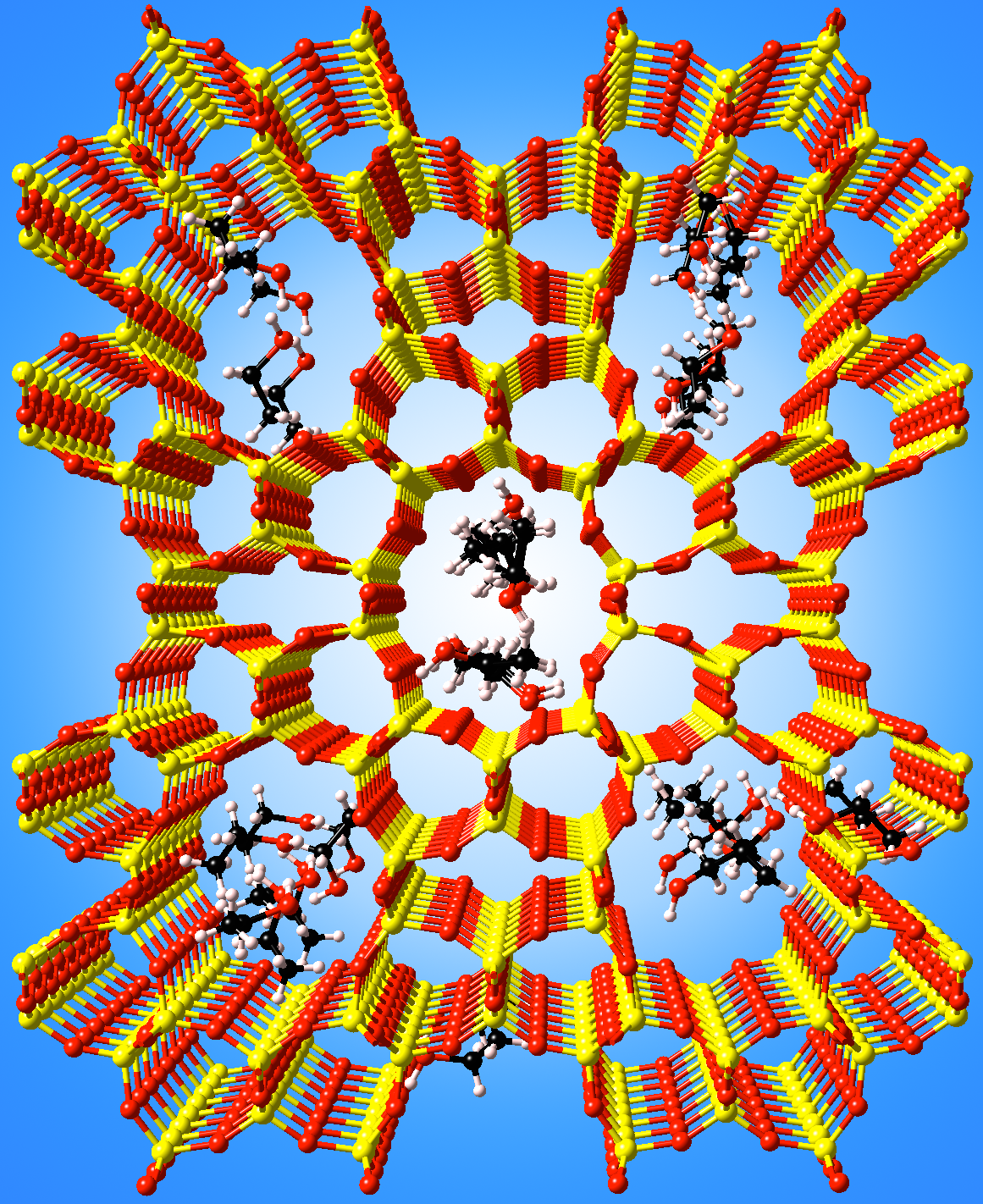
Alcohol molecules docked in a microporous material using MedeA Docking.
Key Features
Automatic combination of host and guest structures
Minimization of steric overlap between host and guest
Automated energy based refinement of sorbate position and orientation
Interactive screen updates, and full user control of model view and scale during docking
Control of simulation length, Monte Carlo temperature, maximum position, and rotation displacements
Combination of multiple sorbates with host structure
Employs Metropolis Monte Carlo Algorithm, allowing user control of the employed search (via control of acceptance probability within the temperature setting)
For use with surface, microporous, and porous materials models
I will say that enzyme and glucoside must fit together like lock and key in order to be able to exercise a chemical action on each other
Emil Fischer, 1852-1919
Required Modules
MedeA Environment
MedeA Docking
Find Out More
To learn more about the use of docking to provide insights into host-guest interactions in materials science, see the following papers on the following topics:
General host-guest interactions [3],
Understanding templating with organic additives [4],
Simulating CFC interactions [5], and host-guest
Interactions in isomerization [6].
- download: