MedeA Deformation - Deformation and Fracture beyond the Elastic Regime
At-a-Glance
Plastic deformation and fracture occur outside the elastic regime and are not easily simulated. The MedeA®[1] Deformation module evaluates the stress-strain relationships of materials beyond the elastic regime, which can be used to extract mechanical properties of materials including Young’s modulus, yield strength, ultimate strength, fracture strength, and shear strength.
Key Benefits
Performs tension, compression, and shear deformations
Fully automated and robust computational procedure designed to achieve utmost efficiency for the mechanical properties beyond the elastic regime
Automated stress-strain curves for results validation
Supports VASP and LAMMPS as the force compute engines
Computational Characteristics
Users define the type of deformation (tensile, compression, or shear), direction (x, y, z, alpha, beta, or gamma), total strain, strain increment, and whether to keep the volume constant by shrinking/expanding the lateral dimensions
All deformed structures are saved in a structure list for easy retrieval

MedeA Deformation uses VASP or LAMMPS for high-performance force computations on computers from scalar workstations, NVidia GPUs, to massively parallel supercomputers.
Creates stress-strain plots automatically for extraction of Young’s modulus, yield strength, ultimate strength, fracture strength, and shear strength.
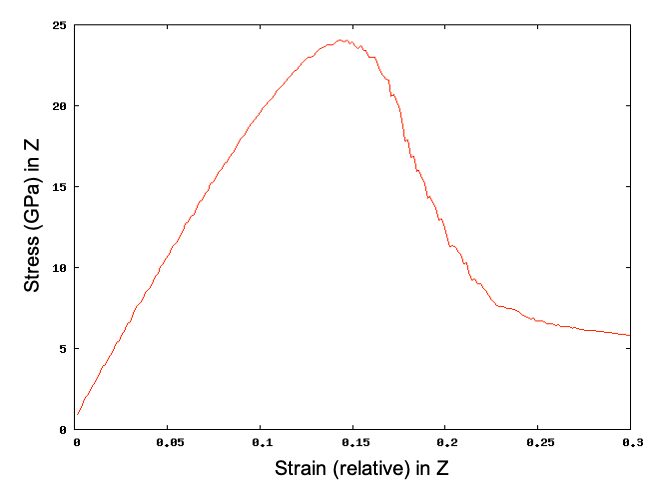
Works with all interatomic potentials in MedeA when using LAMMPS as the force computation engine.
Works with all exchange-correlations and functionals with MedeA VASP.
Required Modules
MedeA Environment
MedeA Deformation
MedeA VASP or MedeA LAMMPS
Recommended Modules
MedeA ReaxFF
MedeA COMB3
Find Out More
Learn more about MedeA Deformation by watching this webinar recording:
Check out this tutorial for additional information:
Introduction to MedeA Deformation: Plastic Deformation and Fracture of Single-walled Carbon Nanotube
- download: