MedeA COD GUI - An Open-Access Collection of Crystal Structures
✓ Part of the standard MedeA Environment
With the MedeA®[1] COD GUI, you have rapid access to atomic structures of the Crystallography Open Database (COD), the fastest growing collection of organic, inorganic, metal-organics compounds, and mineral compounds.
At-a-Glance
The MedeA COD GUI is fully integrated with MedeA InfoMaticA to provide crystal structure data from COD
Key Benefits
Quick and efficient structure search and retrieval
Full integration with all MedeA modules
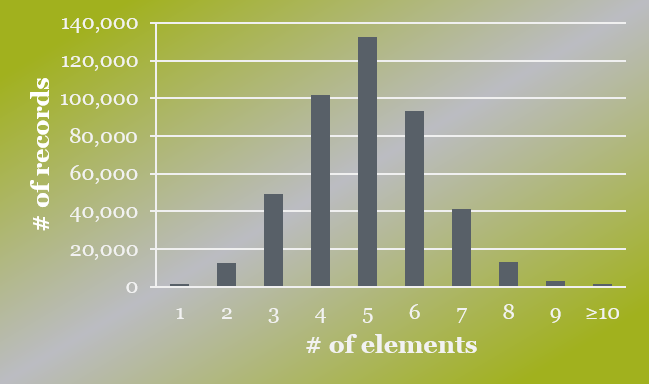
Number of records by constituent count that can be accessed via the MedeA COD GUI
COD started in March 2003, and already encompassed around 10,000 structures in 2004. In 2014, within 11 years, COD accumulated over 250,000 structures. Since then, more than 35,000 have been added to COD each year. COD is recommended by scientific journals to deposit crystallographic data.
With the MedeA COD GUI, you have full access to all COD structure data records and can fully leverage the rich COD content to perform atomistic simulations with MedeA.
Specifications
4.4 GB database file stored on disk
Access to more than 450,000 structure records
Regular COD updates, along with MedeA updates
Key Features
Largest open access collection of crystal structures of organic molecules
Fully compatible with all MedeA compute engines and MedeA property modules
Ideally suited for materials properties screening and optimization
Properties
Detailed information of lattice parameters, symmetry (space group), and bibliographic reference
Atomic coordinates, and interatomic distances and angles
Atomic coordination
Pair correlation function
X-ray diffraction (XRD) powder pattern (radiation source dependent)
Required Modules
MedeA Environment (includes MedeA InfoMaticA)
Recommended Modules
MedeA Pearson
MedeA ICSD
MedeA VASP
MedeA HT-Launchpad
Find Out More
Learn more about MedeA InfoMaticA in the video tutorial: How to Calculate Elastic Constants with MedeA VASP on the Materials Design Youtube Channel.
The Crystallography Open Database, an academic project managed by the Vilnius University Institute of Biotechnology in Lithuania [2]
- download: